Roleplaying Games - A Primer
Por fim, lá me enchi de coragem, e procurei entre ficheiros cheios de pó e outras tralhas afim até encontrar a disquete (sim, este trabalho está guardado numa disquete, sabem, daquelas que só podiam levar 1.3 megas de informação) com o trabalho que apresentei ao meu professor de inglês da faculdade.
Era o Ano da Graça de 1997, eu jogava RPGs à menos de um ano... mas já sabia do que gostava - RPGS. E muito. Para além do trabalho escrito, havia uma apresentação oral. Fiz a minha tendo projetado a meu lado um dragão do tamanho da parede (graças a um retroprojector)-- acho que assustei metade da turma, mas foi divertido.
O trabalho tende muito usar o sistema de Storyteller como exemplo, pois, como já disse, jogava à menos de um ano -- e Vampire foi o jogo com que me estreei -- mas mesmo assim vou tentar manter o texto o mais próximo do original.
Afinal, recordar é viver...
"Monsters, monsters..." - a small gothic introduction on the nature of gamers
Monsters, Monsters, everywhere...
They crowd our imagination. They hide
under our beds. They lurk within the
recesses of our primal unconscious.
You can’t run, you can’t hide - it’s going
to get you. The beast, the ravager, the
‘Lusus Natura’. What is it, and why do
we fear it?
‘What is its name?’
We have always had our Fiends. At one
time, we called them Trolls; later, they
were named Demons, and then they were
Witches who brewed evil potions. Still later,
the Monster was said to be the hungry Wolf,
the Bogeyman, or the Godzilla of the Cold
War terror. Finally, some called it human
ignorance and intolerance. For a time they
tried to tell us that monsters don’t exist at
all, that everything that everything about the
Universe was either known or would be soon.
But now we know better. We have made our
reacquaintance with the Beast. We have
learned its true name. (…)
Today we have caught a glimpse of reality,
and have seen the truth behind the veil. We
have come full circle and rediscovered the
Fiend. We have found that to which we have
given so many names - the source of our
mortal terror.
‘We have found the enemy… and it is us.’
We are searchers(…), searching within
ourselves for that which has no name. By
looking at the monsters we create, we gain
new insights into our ‘darker half’. These
fiends express what are the deepest and
most inaccessible levels of our unconscious,
(…) they are have given us a connection to our
animal self and the promise of a brutal
justice. (…)
Just as the hero of legend must descent into
the pit of Purgatory to face the tormentor,
overcome personal weakness and finally be
cleansed, (…) so must we descend into the
depths of our own soul and return to life with
the secrets we have won (…). Only by
embarking on such a journey can we discover
our true selves and look into the mirror.
But in the end, it is a most disturbing undertaking
(…) - for no journey is ever without its perils. Do
not look into your own soul, unless you are
willing to confront that which you find there.
So remember:
‘There are no such things as monsters…’
in “Vampire: the Masquerade - 2nd edition”
Part 1 - Introduction
‘To be or not to be…’
Shakespeare - “Hamlet”
WHAT ARE “ROLEPLAYING GAMES”?
In Roleplaying Games (or RPGs, for short), one takes the role of a character and ‘plays’ it, as if it was a character in a drama, except that the script is created as the action unfolds. The players take their characters through adventures, called (appropriately enough) stories. These stories are told by a combination of both the wishes of the players and the directives of the Gamemaster.
Thus, the players are free to take whatever characters they prefer - since there is a great deal of different RPGs: from science-fiction, to horror, including sword and sorcery, heroic fantasy, and so on. So, if they want, they can be anything from elves to dwarves, changelings, cyborgs, warriors, etc. RPGs ‘per se’ are a recent phenomenon - but its origins are quite older - and not the ones someone would expect…
Part 2 - Origins and history of the RPGs.
Part II - Origins and history of the RPGs.
‘He who denies his heritage is not worthy of one.’
- “Vampire: the Eternal Struggle” CCG
As it was said before, RPGs have unexpected origins, maybe because they are such natural ones. The act of “role-playing” is much more common than one would expected - for instance, when we are children, playing ‘make believe’, like ‘Cops and Robbers’ or ‘Cowboys and Indians’, we are actually role-playing, as we take the role of someone else.
This basic instinct of ‘assuming the role of someone else’ eventually evolved to more complex games, like, for instance, “Monopoly”, where we take the role of powerful, heartless business tycoons, sellingand buying, mercilessly dealing with stocks, property titles and mortgages, and having a great time doing all those awful things that we would never do in real life.
1 - The Antecedents.
All games like “Monopoly”, where a certain amount of strategy is necessary had the same origin: the old wargames, like chess, fox and hounds, and other forms of highly abstract strategy games. But, in 1824, Von Reisswitz, a Prussian officer, attempted to adapt strategy gaming with real model conflict. And so “Kriegspiel” (which can be translated precisely as “Wargame”) appeared, a game that used topographical maps and metal markings to represent terrain and armies. Dice were used to resolve combat.
Since this game was developed in the early Napoleonic era, it soon became a very popular way to train officers, teaching them to direct their armies. In fact, its popularity was such that it soon spread to other countries.
2 - Historical Background.
Wargames such as “Kriegspiel” quickly became so popular all over Europe that ascended from their military use, and they started to be seen with a hobbyist interest. Shortly after the beginning of this century, H. G. Wells wrote a set of rules called “Little Wars”, that set out the necessary parameters for engaging in battles and resolving combat. Without a shadow of a doubt, “Little Wars” was the catalyst for the development and growth of this gaming hobby.
But it was in the 30s that more development took place: Fletcher Pratt, a Civil War historian and a fantasy author, developed a set of rules for naval engagements, that covered everything: from effects of long-range gunfire, to tracking torpedoes once launched.
Pratt was respected for his historical and fantasy writing, which was an unusual combination for that time. In “The Complete Enchanter”, he tells the tales of Harold Shea, a psychologist-turned-wizard, whose adventures are set in a variety of mythological and fantastic backgrounds. Pratt also wrote two of the best fantasy novels of that period, “The Blue Star” (1952) and “The Well of the Unicorn” (1948).
That strong connection between science fiction & fantasy and the gaming hobby would continue until the present day. But the great master of the fantastic elements was a British professor, John Ronald Reuel Tolkien. Tolkien wrote “The Lord of the Rings”, which he completed in the late 1950s. Initially, “The Lord of the Rings” only got modest reviews. But the elements in it, including the conflict between good and evil, in a fantastic world populated by elves, dwarves, hobbits, orcs and men, would become an integral part of fantasy role-playing.
The 50s were the years of recovery in all sectors, including the games sector - it was when Charles Roberts founded the “Avalon-Hill Games Company” that there was a resurgence of interest in strategy games as a hobby. The games produced by Avalon-Hill, like “Tactics II” and “Gettysburg”, and some design elements invented by the company, such as the hexagonal grid system, used on gameboard maps, would later affect the design of role-playing games. Some of these elements were refined, and new ones were added, by a new gaming company, Simulation Publications, Inc. This was the starting point for the gaming industry as we know it today.
3 - The 60s
By the 60s, there was a well-developed miniatures hobby and a growing strategy game hobby, although both were very small in numbers and scale. But two elements caused an unexpected revolution in the miniature and gaming industry. The first one was the publishing of “The Lord of Rings” as a trade-paperback, which received the highest praises. It caused various 'sword and sorcery' novels to appear, including Robert E. Howard’s books about his barbarian hero, Conan of Cimmeria.
The second was the creation of a set of medieval rules called “Chainmail”, written by the British Jeff Perrin and Gary Gygax. Until that moment, all miniatures were very similar, and where only different from one another when they belonged to different armies. The damaged they caused and their movement velocity was set and true for the entire army. But “Chainmail” had given players the possibility of individual combat, which lead to a new kind of miniature – each had unique and different abilities. With such a high level of detail, the miniatures also started to develop unique and different personalities.
And thus appeared tabletop games as they are known today.
4 - Tabletop Games.
Tabletop games resemble greatly the original wargames: two players wage their armies of creatures (that can be anything from humans to dark elves, including robots) against each other. The combat unfolds on top of a special table (hence the term ‘tabletop’), where there is a whole set of elements (in 3D or not), such as rocks, hills, lakes or even castles, which represents the 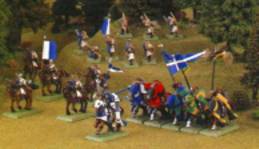 battlefield. Each army is different from the other (even if both players are using, for instance, an human army), because within each army there are many different creatures, each with their own abilities, and each player will probably combine them in a different way from his opponent.
Tabletop gaming is an interesting hobby, however it has several drawbacks.
First and foremost, it is extremely expensive - for instance, foot soldiers or infantry (the less powerful, they are the ‘cannon fodder’ of any army) are sold in packages of four, and cost between 1400 to 2000 escudos. Furthermore, the figures regarded as individuals (they have their own name and personal history), have an astronomical price - such as Warhammer’s “High Elf Dragon Lord” figure, which costs around 10 500 escudos! Therefore, one has to be extremely wealthy or will have to wait a long time to have a half-decent army. It is particularly annoying for a good player with a weak army to face a low-class player with a strong army, since it is likely that the latter wins just for his better army.
Secondly, all figures come unpainted (and some of the larger ones even come unassembled), and their small size makes them extremely hard to paint (specially if one does not have any talent for painting at all).
And finally, tabletop can be very repetitive and dull. After all, it is always the same principle: war between two armies - there is no other type of interaction.
That was the problem that Gygax had experienced - but, when he came across Tolkien’s “The Lord of the Rings”, he discovered a way to solve it.
5 - Of Dungeons & Dragons
Gygax wanted to make tabletop games more interesting, by making each gaming session unique and different from the previous. It was then he decided to create a set of rules that would allow to send one’s miniatures in quests against monsters and evil wizards instead of sending them against another player’s army. So, near the end of 1973, “Dungeons & Dragons” was published by Tactical Studies Rules (TSR).
The company was utterly caught by surprise by the success of the game and the demand of the public that ensued, as the book sold out at an impressive rate. Gygax realised he had found a gold mine. So he immediately started to think how he could improve it, how he could advance into the next level of gaming.
6 - Into The Next Level - Advanced Dungeons & Dragons.
Gygax realised quickly which were the changes he could make to improve “Dungeons & Dragons”, and so the miniatures were removed from the game and left forever for tabletop playing. The rules of “Dungeons & Dragons” were adapted to a new sort of gaming - one where there was no need for miniatures anymore. All it was necessary was the player, a sheet of paper and some dice.
And thus was the first role-playing game born - from that point on, RPGs became more and more popular, and, since then, hundreds of games have been published.
7 - The Future.
Since the publication of “Advanced Dungeons & Dragons” in the 1980s, many other games have been created. The popularity of role-playing games quickly spread all over the world, and, thanks to the Internet, today is already possible to play online with role-players from all over the world. Instead of paper, pencil and dices, one uses a monitor, a keyboard and special software to simulate dices. And instead of gathering all your friends in your living-room, you simply get online with players from all around the globe, by accessing special Internet sites like White Wolf’s, at http://www.white-wolf.com.
8 - Portable Role-Playing Games.
Recently, a new kind of RPG appeared. Technically speaking, they are not RPGs ‘per se’, but they borrowed many elements from them. Collectible Card Games (‘CCG’ for short) are similar in many aspects to both RPGs and tabletop games.
Basically, the objective of a CCG game is to defeat an opponent by means of an army of minions (that can range from anything, from unicorns to minotaurs or even vampires), empowered by special items, weapons and abilities, all represented in different cards.
Games such as “Magic: the Gathering”, a game where one assumes the part of a powerful wizard, or “Vampire: the Eternal Struggle”, where the player takes the role of a Methuselah, an ancient vampire, are examples of CCG games.
A normal RPG is something that requires some patience and a lot of imagination to organise. The Gamemaster has to prepare the story in advance, check the players’ characters, find a place where to play, and a lot of other things that must be thought of before a game is started. CCGs, on the other hand, can be improvised and played anywhere, only with two players, if necessary. No Gamemaster is required, nor creating a character, just having a deck of cards.
However, like tabletop games, CCGs are much more linear: the objective is always the same – to defeat the player’s army. And, although they aren’t as expensive as tabletops, CCGs are much more expensive than RPGs, since a deck still costs more than paying for a couple of photocopies of the character sheet. Furthermore, in order to have a more powerful deck, it is necessary to buy a few more decks to get different cards.
Part 3 - Types of Roleplaying Games
Part III - Types of Role-playing games.
‘He who cannot forgive the next man for being different is still far from the path of wisdom’
- Chinese proverb
Listed below are five categories in which most RPGs can be inserted in:
1 - Heroic-Fantasy and Sword & Sorcery:
‘All it takes is one person to change history.’
“Luftwaffe: 1946”
Heroic-fantasy was the initial theme for RPGs. Its most famous example is the first RPG ever, “Advanced Dungeons and Dragons”. Games that belong to this category are usually set in somewhat mystical and fabulous kingdoms, where magic reigns, and all sorts of intelligent creatures, such as orcs, elves, changelings, fairies, etc., live side by side with humans.
These games have a medieval background, with kings, castles, melee weapons and battles on horseback. Sword & Sorcery is similar to heroic-fantasy, except that, in Sword & Sorcery, the members of the party are usually all human (mages, warriors, priests, and so on) whereas in heroic-fantasy the players enjoy the possibility of being something else than human.
TSR’s “The Fifth Age”, based on the “Dragonlance” books, is an example of Sword & Sorcery games, since its rules were created to build mainly human characters.
In these games, players usually use their swords, axes and magical powers to fight monsters, to save damsels in distress, or (if they don’t like being the ‘good guys’) to go around in search of treasures, trying to get as wealthy as possible.
2 - Science-Fiction
‘The only way to discover the limits of the possible is to go beyond them into the impossible’
Science-fiction has a wider range of possibilities than heroic-fantasy. Big guns, cyborgs, aliens, deadly viruses, beautiful girls clad in mechanical armours, are but a few of the elements included in this category, since science-fiction includes that which is related to science and/or pseudo-science.
Furthermore, many successful films are turned into RPGs, such as “Star Wars”, “Star Treck” and “Aliens”.‘a faraway galaxy’; White Wolf’s “Aeon Trinity” occurs in the 22nd-century Earth, while “Predator” is also set on Earth, but during the present day. Unlike heroic-fantasy, there isn’t a set period of time or space for science-fiction games: “Star Wars” happens during an unknown time, in
In this category, technology usually has a very important role in the game, even if the game is set in a 19th century Earth from an alternative dimension.
3 - Horror
‘As others might with tenderness
Rule your life and youngness
I shall rule you with a fear.’
Beaudelaire - “The Ghost”
Fear is connected to the deepest recesses of the human mind, thus, it has always been an important part of human nature. That which scares us also attracts us. Therefore, horror RPGs had to be created sooner or later. Horror RPGs are usually set in our own reality and time, although there are some horror RPGs set in space or even during Middle Ages.
One of the most famous horror RPGs is “Call of Cthuhlu”, based on the writings of R. Lovercraft. It is usually set in America, during the 1920s, (although there are supplements that allow to create stories set in modern-day America), and tells the tales of normal men and women that suddenly come face to face with monsters, demons and similar creatures. The players’ characters have no special powers, and not only do they have to fight for their lives, but also for their sanity, for there’s so much their minds can stand.
Most horror RPGs assume the same point of view - of the human fighting his own fears and nightmares, but in the beginning of the 90s, a new game took the horror RPGs into a new level: in White Wolf’s“Vampire: The Masquerade”, the player was, for the first time ever, the monster.
The players assume the role of young vampires of the 90s, who have to deal with the fact that now they are immortal, but also have to feed on blood in order to survive. The monster’s point of view and everything connected to it, is what counts most. Several other books based on that same “World of Darkness” series followed (a darker, bleacher and more gothic version of our reality), allowing the players to become werewolves, ghost, mages and even changelings.
4 - Humour
‘He who laughs, LASTS’
“Humor Digest - July 1990”
Like for instances, “Project A-Ko”, based on a series of Japanese animated films, where the peaceful Graviton City is in-vaded by bikini-clad female aliens (who look like male earthlings), determined to rescue their long lost prince, who happens to be your best girlfriend. Or where you solve your rivalries in an all-girl school by unleashing the entire arsenal of a 6mt robot upon your rival, blasting her into the stratosphere. On a slightly different tone, it is also possible to recreate Monty Python’s hilarious adventures in “The Holy Grail”, where King Arthur’s quest is mercilessly criticised, or even to take part in modern-day quests with “The Knights of the Dinner Table”.
In short, humour RPGs are similar to other RPGs, except their goal is to give an enjoyable time to the players through amusing situations and even through some nonsense.
5 - Warriors
‘He that wrestles with us strengthens our nerves, and sharpens our skill. Our Antagonist is our helper.’
E. Burke
Since we were children, we have always dreamt of being stronger than we are: police officers, detectives, cowboys, secret agents, super heroes. In short, we wanted to be the modern day warriors, who fought the ‘bad guys’ and defeated evil, just like we saw on TV. Later, we would start to admire the fighting prowess of the street fighters that filled the arcade games which we usually played with our friends. A few years later, we would leave those nigh super-human powers behind, and envied the abilities of humans who were mentally and physically superior to the average, of great leaders such as Napoleon or Alexander the Great, or even the fabulous tales about ninjas and samurais.
In these RPGs, the objective of the players is to be warriors, either by waging battles behind a desk or on the battlefield - games such as“Legend of the Five Rings” unveil the secrets of ninjas and their clans to the players. It is possible to play as a fighter or a consort, a leader or a spy, as in most of the games that belong to this category. They all have in common the fact that the player assumes the part of a warrior, whose abilities can range from fencing to love-making or even strategy.
6 - Others
Obviously, the list of RPGs is almost infinite. Therefore, it is impossible to list all of them, as well as all the categories, specially because many are so unique that they require their own category.
It suffices to say that there is hardly any theme that has not been turned into an RPG. The series we see on TV, (cartoons included), Hollywood blockbusters, periods of the history of mankind, books, and so on, ‘ad nauseam’, have been sources of inspiration for RPGs, often more than once. RPGs search for inspiration everywhere, and perhaps that is the secret for their success - there is always something for everyone.
Part 4 - Starting A Game Session - The inner workings of a game
Part IV – Starting a game session - RPGs inner workings.
‘Cry “Havoc!” and let slip the dogs of war.’
- Shakespeare – “Julius Caesar”
A group of people, usually called a ‘troupe,’ gathers around a table, each representing a different character – except for one – that will take the most important part of all – usually known as the Gamemaster.
1 - Elements required for RPG playing.
All these elements are essential for a RPG game session. They range from the people involved in the role-playing, to items without which would be impossible to play. Only the essential elements will be referred here, although there are many others that can be used during a RPG session. They don’t affect the game directly, as they only contribute to enhance the mood, like background music, or props to make things more realistic, such as a model fingerprint-filled handgun.
a) HUMAN FACTORS
- The Gamemaster - the Gamemaster (also known as Storyteller or Dungeon Master) is, without a shadow of a doubt, the most powerful person of the game. It is him/her that builds the scenario on which the players’ characters will have their adventures, and s/he has also to lead the characters throughout the story, s/he created. The Gamemaster is similar to the banker in “Monopoly”, only with even more responsibility – s/he is also the referee in the game, his/her word is final. The Gamemaster is like God in the universe of that game s/he is leading – she has in his/her hands the final fate of all the characters. It is also him/her who decides what events occur, and when they occur. In some occasions, the Gamemaster will even decide if players fail or succeed in an action – although such decisions are usually left to the element of luck.
- The Players – of course, it would be impossible to have a game without players. The same happens with RPG games: here, players create characters that they will interpreter in the story created by the Gamemaster. They determine whether the characters stay or flee, talk or charge, turn left or right. The players have an important role in the game – they can even decide the outcome of the story – for, although the Gamemaster creates the story and its background, s/he cannot decide the outcome of every events, s/he can only guess the probable reaction of the players, and develop the story accordingly. Gamemasters are often forced to improvise when players take unexpected actions, for which the Gamemaster was not ready. For instances, let us consider this possible situation:
The characters have just left an abandoned city, where the treasure that they are looking for is. The Gamemaster (ironically) has given them clues showing that the treasure is there, but is expecting them to overlook the obvious and to follow the other clues – one telling them to go to a temple to the East, and the other telling then to go West.
No matter what their choice is, after facing a few enemies, they will discover that the treasure was actually in the abandoned city and will return there. But, to make things a little harder, by the time they arrive at the city, the king’s army (which is pursuing the characters) will be waiting for them.
A Gamemaster knows that an entire army cannot simply materialise out of nowhere – factors such as distance and velocity count, and a good Gamemaster has to take them into account. Therefore, the false clues will draw the characters away, buying the king’s army enough time to arrive at the abandoned city in time to confront the characters. The Gamemaster is only expecting the players to decide whether the characters go West or East.
If they go West, they will cross paths with a bunch of thieves. After the characters defeat them, the thieves will admit that they were going to the abandoned city because the treasure is there. If the players decide that the characters should go East, they will find a priest possessed by an evil demon. After destroying the demon, the priest will thank them for releasing him, and will inform them about the whereabouts of the treasure. The characters will return to the city and face the army, no matter what choice they make. At least, that is what the Gamemaster is expecting.
But it is always possible that one of the players realises what the clues actually mean, and the characters decide to return to the city at once. The Gamemaster knows that the king’s army will not arrive in time, so s/he will have to improvise something to keep the characters occupied until the army gets there, like a few (weaker) enemies for them to battle with.
The players have total control over their characters’ feelings, thoughts and reactions, and no Gamemaster has the right to take away that control, unless it is a lousy Gamemaster. In the situation mentioned above, the correct reaction was to improvise something to delay the characters, but it would be possible for the Gamemaster to claim “no, you cannot return to the city, you either go East or West”. However, players resent having the control over their characters being taken away, and would probably start suspecting that there was something nasty awaiting them, either if they go East or West. Paranoid players are dangerous, since they tend to hesitate too much and often avoid doing things which are crucial to the development of the story.
Basically, the players are the actors in a play sketched by the Gamemaster, and it is them who will flesh out the details of the story.
b) STATIC ELEMENTS
- The Books – books are an essential part of RPGs, specially concerning the creation of the story that will be role-played, since they describe the universe where the story will occur. It would be nearly impossible to role-play an “Vampire: the Masquerade” session, if one just had an “Advanced Dungeons & Dragons” book.
There are many types of books, and each has its own part.:
* the more important books are the called ‘core books’. They contain general information about the most important aspects of the universe where the story will occur, as well as the rules for combat, construction of characters, and so on. These books alone contain enough information to create an endless amount of stories to be role-played.
* the called ‘supplements’ add extra information to the one given in the core books. Supplements can range from information for Gamemasters only, about enemies, cities, etc., to special information for the players, to help them to better understand the workings of certain aspects of the determined types of characters, like magic compendiums, clan books, etc. For more advanced players, supplements allow to introduce something new to the game, elements that usually are not mentioned in the core book or which the rules do not contemplate, like different eras, clans or creatures that are considered too powerful to be played by normal players, and that are usually used as opponents and enemies of the characters.
- The Character Sheets – character sheets contain the character ‘stats’, i.e. what the characters can or cannot do, how well (or badly) they do it, and often other information, such as their physical appearance and even their personality. In the character sheets, elements such as health, humanity and sanity ratings are also included, depending on the RPG. Character sheets usually vary from RPG to RPG, although, for example, “Advanced Dungeons & Dragons” and “Ravenloft” have the same rules and character sheets, in spite of their universes being different.
The character sheet also determines how the character will be created. In some games, like “Advanced Dungeons & Dragons”, luck is part of the construction of the character – the player decides which type of creature the character will be, then will roll dice, and the results will decide the rating of each trait. In other games, such as “Vampire: the Masquerade”, the player has already a set amount of points and will distribute them as sees fit: the character can be stronger or more intelligent, can be a genial hacker, but with little ability to do anything else, or a regular person who knows a little of everything.
- The Dice – when we were children playing “Cops and Robbers”, the ‘I shot you!’ ‘Did not!’ ‘Did too!’-problem arouse. This also happens in RPGs – there are certain situations that must be solved, whose outcome is necessary for the story to proceed. How is it possible to know when the characters fail and action or not? In some cases, given the difficulty of the action, the Gamemaster can decide the outcome, like for instance, that there is no problem for a character to get dressed in the morning, or that it is impossible for a normal human character to jump 10 meters up into the air. However, not all decisions can be made thus. Let us think on the following situation:
The characters are running away from the king’s men. Suddenly, they find themselves in a dead end, with a 3 meter wall in front of them.
One of the characters is not all that good in athletics, so the likely result of his attempt to climb the wall is that he will fail and fall into the hands of the king’s men. But one never knows – there is also the possibility that the character will get lucky and manage to climb the wall – the so called ‘dumb luck’. How can we know when it happens? That is when the element of ‘luck’ is used: by rolling dice, there is always a fair chance of succeeding in an action… or failing. Of course, the higher the ratings one has in a determined trait, the better chances one has of succeeding in an action related to that trait. Nonetheless, no matter how good the character is, there is always the possibility of failure – nobody is 100% perfect. The dice also determine how well or badly the character did in an action – it can be a complete success or a total failure, where the action has real nasty repercussions – the called ‘botch’: for instances, a character fails a shot and instead of shooting the enemy, shots a friend.
2 - Preliminary work
a) CREATING A STORY – only the Gamemaster is involved in the process of story creation. After it has been decided which RPG game will be used, the Gamemaster will sketch a story, that will be fleshed out later by the players decisions. The Gamemaster has to leave a lot of manoeuvre room to the players, so that they fully enjoy their role-playing, by giving them the possibility of letting their characters do what they want. Of course, there are some events that the characters will not be able of escaping, events that lead to the development of the story, and the Gamemaster is should also always keep something up his/her sleeve, in case s/he has to get the players back in line, without taking away their control over their own characters. In this stage of creation, things like enemies and eventual allies, who will be role-played by the Gamemaster, are also created.
Description is also an important part of role-playing – it helps setting the mood, and, in the more crucial moments of the story, the Gamemaster should have already a ready description of what the characters are facing, whether it is an enemy, a treasure or a monster, so the players can feel the full impact and the true importance of what (or who) they are facing.
b) CREATING A CHARACTER – this is a joint effort of both the player and the Gamemaster. Usually, the player is free to decide how the character will turn out in the end, but in some cases, the Gamemaster can add some restrictions to the process of character creation, like, for instance, lot allowing the character to be part of determined races and/or clans. In most of the cases, however, the player is utterly free to decide how the character will be.
Example of a character creation process:
Ana plans to participate in Sónia’s new “Vampire: the Masquerade” chronicle. Sónia simply informs her that the story will centre around a mysterious vampire. Since she adds no further information, Ana will have a lot of manoeuvre room when creating her character. Firstly, she will gather some ideas, then start the process of turning those ideas into a full-fledged character.
Step One - Concept
Ana’s first responsibility is to come up with a concept for her character. She is feeling like playing someone who is carefree and good-humoured, but also extremely straightforward, someone who does not give a damn about the political games of vampiric society, so, she decides to role-play a female vampire, whose lifestyle did not change much after being turned into an undead. The obvious clan choice would be the Brujah clan, the violent, in-your-face vampires. But to add a twist, Ana chooses the Gangrel clan, the nomads, nature-lovers, and independent vampires. However, she soon decides that the character will not be an average Gangrel – the character does not really care about nature, and has a city life, opposing to most Gangrel vampires.
Recently, Ana has been reading a book about the adventures of two female bounty-hunters from Chicago, and one of them suits the character perfectly – so, Ana already has a name for her character – May Hopkins, also known as Minnie-May.
She decides to adapt the book character to her own character: so she considers Minnie-May’s Nature and Demeanor. She decides that Minnie-May is someone who enjoys all the pleasures of life, so her Nature will be Bon Vivant. At the same time, those who know Minnie-May see her as someone who loves danger in every form – that’s her Demeanor – the face she shows to the world. Thrill-Seeker is the perfect choice. And since Ana has definitively adopted the Minnie-May from the book to be her character, the character’s concept is already chosen: Bounty Hunter.
Step Two – Attributes
At this stage, Ana has to choose what Attributes (physical, social or mental) are more important. Since Minnie is a Bounty Hunter, Physical should come first – she will have to face thugs and all that. So, this is her Primary Attribute. She gets 7 points to distribute as she see fit. All attributes start automatically with one dot, so Minnie will have a total of 12 dots in her physical attributes. Minnie is still young so she’s not that strong – Ana only spends one dot in Strength, increasing to two – Minnie has average raw strength. However, Ana boosts Minnie Dexterity to the limit – Minnie is agile and nimble. Finally, the last dots go to Stamina, increasing it to three dots – it is important that Minnie is resistant to pain and damage. Her Secondary Attribute is Mental – Minnie does have to be clever and intelligent to solve the complicated situations a bounty hunter has to face. She has 5 dots for this attribute – two go to Wits and other two to Intelligence (in the book, Minnie-May is an explosive specialist, so Ana has already decided her character will be like just the book – and it does take some brains to handle explosives). The last dot goes to Perception – how Minnie will perceive the world around her – it is just average, but it suits Ana just fine. By default, Social Attributes are Tertiary. Ana has 3 dots. Minnie-May is a cute girl, so Ana spends two dots in her appearance, increasing it to three – more than average. With a bit of luck, Minnie’s looks will help her distract the thugs while she kicks their sorry behinds. The final dot goes to Charisma (Minnie is a nice girl), and although her Manipulation is unusually low, Ana doesn’t find it very important, since her character does not care about politics and sweet-talking at all – it suits Minnie’s personality perfectly.
Step three: Abilities
Now, Ana has arrived to the point where all the important choices are made, where her character starts emerging from the crowd. Like in the Attributes, Abilities can be Primary, Secondary or Tertiary. Ana ticks the abilities she considers more important and in the end she realises that Minnie’s Talents will be the Primary Abilities. She has 13 dots to distribute. She places 3 dots in Alertness, since she feels that a Bounty Hunter should never be caught unaware, and that alertness will also prevent her from falling into traps or ambushes. Then, two dots go to Athletics, as Minnie is in shape. Since, in combat, both Dexterity and Brawl count, and as Minnie has an incredible Dexterity (5 dots!), Ana thinks that one dot in Brawl is enough. However, Dodge gets three dots, for Minnie is small and agile. Ana has four dots left, so she puts two in Streetwise (it will help Minnie finding her prey) and Subterfuge (it represents the ability of deceiving, and it is useful to compensate Minnie’s low Manipulation abilities). The next ability are Skills, and she has 9 dots to spend: two dots go to Drive, one to Etiquette (Ana suspects that the mysterious vampire is an Elder, so a little etiquette will save her a lot of headaches), two dots go to Firearms (a girl has to know how to defend herself, and a gun is easier to find than explosives), likewise, she puts one dot in Melee (stabbing weapons are not as effective as guns, but sometimes they come in handy). Security is important as it is what allows Minnie to disable alarms, pick up locks, open vaults, and all those things are useful for a Bounty Hunter. She puts the final dot in Stealth, the ability of going undetected – also very useful for a Bounty Hunter. Finally, the Knowledge ability, it has 5 dots. Immediately, Ana spends four dots in Science and adds the speciality – ‘Explosives’ – after all, Minnie is an explosive specialist – she has to know what she is doing. The last dot goes to Investigation – Minnie needs to know how to track down her prey.
Step four - Advantages
Now, these are the traits that will make a vampire out of Minnie.
Disciplines , the mystical powers vampires possess, come first. As a Gangrel, Minnie can choose between Animalism (the ability of controlling and communicating with animals), Protean (shape-shifting abilities) and Fortitude (super-human resistance). Usually, Ana would only have three dots to put in disciplines, but Sónia tells her that she can have four dots. Ana then puts all dots in Protean – Minnie can now see in the dark, grow claws, meld into the earth and transform into animals.
There are five dots to spend with Backgrounds. Ana chooses only two of the many available possibilities: three dots into Resources, which make Minnie quite wealthy – bounty hunting does give a lot of money -, and two into Generation – by default, vampires start at 13th generation, but the lower their generation is, the stronger they are. Minnie is now an 11th Generation vampire.
There are seven dots to distribute among Virtues, plus one automatic dot on each Virtue. In spite of being a vampire, Minnie is still kind and human, so she gets two dots in Conscience, raising it to three – more than average. Ana does not want her having fits of uncontrolled rage, to which vampires are prone to, so Minnie gets two dots in Self-Control, increasing the rating to three. The last three dots go to Courage – Minnie is a brave girl – she has to, to be a Bounty Hunter.
Step Five – Finishing touches
Now, Ana has the chance to round out her character and add it a spark of life.
Firstly, she calculates Minnie’s Humanity rating, by adding Conscience and Self-Control. The result is six dots – Ana finds it a little too low for someone as Minnie, so she makes a mental note to increase it later. Willpower equals the Courage’s rating, four. Ana makes another mental not to increase it – it is also too low. If Minnie is going to face Elder vampires, she will need to be strong-willed, not to succumb to mind-controlling.
Next, Ana will spend the freebie points that are given to increase her attributes, abilities and advantages as she sees fit. She spends a dot in Knowledge, Linguistics (the story is happening in Portugal and Minnie is American – she has to know how to speak Portuguese, otherwise she will have a lot of communication problems, which will make the story too difficult). Then she decides to put another dot in disciplines, this time, Fortitude – Ana wants her to be able of resisting to damage. Instantly, Minnie has an extra health level, which Ana indicates, by adding another square to the initial seven. In order to make her even more unique, Ana adds two dots to Minnie’s Generation, four dots in the total, making her a 9th-Generation vampire – as a result, Minnie’s Blood Pool has four extra levels, added to the initial ten, and Ana writes Minnie’s Generation in correct box. One dot is added to Minnie’s Courage – she is supposed to be real brave – that adds automatically one dot to her Willpower rating, which is now five. It is still too low, so three dots increase the rating to eight – which is now high enough. Another dot increases Minnie’s Humanity to seven – enough for what Ana has in mind. The final point goes to Skills, Survival.
Now, the character is ready. Ana hands the character sheet to Sónia, the Gamemaster. After looking at it, Sónia decides that the character is okay, and even decides to give Minnie another bonus – 2 dots in Potence (supra-human strength), since it is a very physical character. And thus the character creation process ends.
3 - Let's play!
The troupe gathers around a table: the Gamemaster with his/her story, the players with their character sheets, plus books, dices and a healthy amount of junk food – now they are ready to start playing.
a) TIME – over the course of the game, time is presumed to pass normally – Tuesday follows Monday, February follows January, and so on. However, there is no need to role-play every second that passes. There is some difference between the speed of the game time and the real time. For instance, a four-hour session can contain events that occurred during a year in the game setting. During special actions, such as combat, time can be ‘stretched’, in order to make things less complicated.
In order to maintain a sense of passage of time, but without making the game tedious, there are six basic units to describe game time:
- Turn – the amount of time necessary to take a simple action, like throwing a punch or picking a book from a shelf, it can range anywhere from three seconds to three minutes.
- Scene – like in plays and movies, a scene is a compact period of action that takes place in a single location. It can be a conversation in a park or the investigation of a murder scene.
- Chapter – an independent part of a story, usually played in a single game session. It consists of a number of scenes – essentially like a chapter in a novel or a play.
- Story – a full tale, complete with introduction, rising action and climax. Some stories can take several chapters to be completed while others may be finished in just one.
- Chronicle – a series of stories connected by the characters themselves and their own personal story, possibly even by a common theme or plot.
- Downtime – time that is spent through a description, instead of being role-played turn by turn and scene by scene. If the Gamemaster says “the characters wait in the dungeon for four hours before being taken to the King”, instead of actually letting the players role-play their wait, the Gamemaster is considered to be invoking downtime. Downtime allows trivial or tedious passages to go by quickly.
b) ACTIONS – Over the course of the game, a character will do many things. Some of them will be considered ‘actions’, while others will not. Speeches and conversation are not considered actions – but just everything else, from throwing a book at the guard’s head to trying to decipher a code, is probably an action.
It is easy to attempt an action – the player simply has to tell the Gamemaster what the character is trying to do and how the player is planning to do it. Loading a gun or crossing the street , for example, are easy enough to be considered automatically successful. On the other hand, if the character is trying to reload while he’s hanging from a fire escape by one hand, or trying to cross a highway full of speeding autos, there is the chance the character will fail the action. When there is the possibility of failure, the player has to roll dices. The Gamemaster will decide which is the minimal dice result that the player will have to achieve, so the action can be considered successful. For instances, loading a gun poses no difficulty at all. However, loading it while hanging from a fire escape poses a difficulty. Trying to reload the gun while hanging from the fire escape, while being attacked by enemies is even more difficult.
C) ROLE-PLAYING! - The following excerpt will be a scene from a “Vampire: the Masquerade” chronicle, with Sónia as the Gamemaster, and with Ana as the player of the character “Minnie”-May Hopkins, a 9th-Generation Gangrel vampire.
Sónia tells Ana that, when Minnie-May returns to her apartment, she finds it in a complete mess, and in the centre of the living-room is her housemaid’s dead body, lying in a pool of blood. Minnie also realises that her little brother is missing. Since Ana told Sónia that Minnie’s little brother means the world to her, Sónia asks Ana to roll dice for Minnie’s Self-Control, to see if Minnie-May can control herself and not go berserk out of pure rage. Ana does as she is told and has one success – Minnie is controls herself – barely.
Ana decides that Minnie will investigate around the house, so she informs Sónia that Minnie will start that action – Sónia tells Ana that before that she has to roll for Alertness, without telling the player why. Ana gets three successes – more than enough. Sónia informs her that Minnie is hearing sirens outside her house. Ana realises that someone is trying to frame Minnie-May – she remembers the housemaid’s body in the living-room - so she tells Sónia that the character will run to the back of the house, and look out a window to see if there is someone in the alley behind the building. Sónia tells her no, so, Ana says that Minnie will jump out the window. The Gamemaster is surprised and remembers her that Minnie lives in the 3rd floor. Ana insists, and Minnie crashes painfully three floors below. She is severely wounded, but since her generation is unusually low, she can heal herself in just a few turns – no more than five minutes in game time - and she escapes without being caught.
As a vampire, Minnie-May has supra-developed senses, so Ana has her tracking her brother by scent. Since it is a Summer night, the trail is easy to follow, though the kidnappers escaped by car, so Sónia adds no special difficulty to the tracking action. The trail leads Minnie-May to a warehouse in Matosinhos.
Ana is prudent, so she has Minnie investigating the warehouse before barging in. When she looks through the window, Sónia informs Ana that Minnie sees her little brother being tied down to a chair. Ana hesitates, since there are several armed men inside the warehouse – it is a trap, without a shadow of a doubt. She wonders whether she should have Minnie backing out and go call the police. But this does not suit Sónia’s plans at all – she wants Minnie to engage in combat with the thugs. So she tells Ana that the boy starts crying for his sister, and one of the men hits him. This calls for a Self-Control roll with a very high difficulty and – too bad – Ana fails the roll miserably. Minnie-May enters a state of uncontrollable rage – and storms into the warehouse.
Ana tells Sónia that Minnie will activate level two of the Protean discipline, which enables her to grow the “Wolf Claws”, two-inches long claws, and Minnie charges. There are four men in the warehouse, and since they are caught unaware, Sónia informs Ana that Minnie-May killed the first one instantly. However, the second man is running away, so Ana will have to roll Minnie’s Dexterity + Brawl to hit him. Ana scores four successes. Sónia, taking the role of the man, rolls his Dexterity + Dodge – the man is trying to get away unarmed. He gets two successes – Ana had more successes, so the man falls to the floor with his throat cut open by Minnie’s claws. But the remaining two men have already recovered from the initial shock and are ready to strike back, so they are threatening Minnie-May with shotguns: Sónia rolls the first man’s Dexterity + Firearms and he gets three successes. Ana will have Minnie dodging, so she rolls her Dexterity + Dodge – one success only – the action was not successful – Minnie is hit. The damage caused by such a weapon would usually be enough to put down most vampires, but since Minnie has Fortitude, she is more resistant than most – Ana rolls Minnie’s Stamina and gets two successes – Minnie is standing. Barely, but standing nonetheless. Ana tells Sónia Minnie will attack the man at once, trying to take him down before he can shoot again. However, (without Ana noticing it) Sónia rolls Dexterity + Firearms for the second man, who Ana totally forgot. The man gets 2 successes, and Sónia informs Ana of what happened – Minnie gets hit from behind by another shotgun pellet, and this time it is too much even for her to stand. Minnie-May is down for the count – she is now lying unconscious on the floor.
Appendix
The following list of terms are ‘common parlance’ among RPG players, and are listed here for an easier reference.
- Action - when it is the performance of a deed or activity. When players announce that their characters are doing something, they are taking an action.
- Automatic success – the character has to perform any action that is extremely simple, or where there is hardly any possibility of failure, the action is automatically considered successful.
- Botch – when an action is miserably failed. It causes the action to be failed as well as something extremely unpleasant to happen.
- Character – 1) each player creates a character, an individual that the player will role-play over the course of the chronicle. 2) any other individual that takes part of the chronicle, either allies, friends or enemies.
- CCG – short form for Collectible Card Games, games played with an army of creatures represented by cards.
- Core books – the main book of a RPG – it defines its universe and rules.
- Difficulty – the measure of how hard a certain action is. It varies accordingly to the situations in which the characters are involved.
- Downtime – the time spent between scenes, where no role-playing is done. Action may be made, and the Gamemaster may give some description, but generally time passes quickly.
- Dungeon Master – vide ‘Gamemaster’
- Gamemaster – the creator of the story, and the referee at the same time. S/he controls all events and characters that cannot be controlled by the characters.
- Roll – tossing dice whenever an action requires it.
- RPG – short form for Roleplaying Game.
- Scene – a single episode of the story, a time and place where actions and events take place.
- Score – the amount of successes a character gets after a roll.
- Session – the gathering of a troupe, to role-play.
- Storyteller – vide ‘Gamemaster’
- Success – when the result from a roll is high enough to surpass the set difficulty.
- Supplements – books which supply extra information on a determined RPG, besides the one contained in the core books.
- System – the set rules for a RPG, and that usually varies from game to game.
- Tabletop game – game played with small iron figurines, representing an army.
- Troupe – group of players, including the Gamemaster, who play any RPG on a regular basis.
- Turn – minimal unit of time, during which a character can perform a simple action.
Final Word
A Final Word:
What makes RPGs so popular?
What is the secret of their success?
Maybe it is because they seem to have something for everybody, because they can satisfy every desire. Or maybe it is because they allow us to return to the good old days when people got by the fireplace, weaving stories to try to impress others. That was the spirit of storytelling. That is the spirit of role-playing.
Maybe it is because of all those reasons.
Or maybe it is because it is just ‘fun’.
No matter. What matters is that Role-playing is amusing, cheap and allows you to be someone else, somewhere away from the dull routine, or even someone who you always dreamt of being, like for instances a armoured knight in shinning armour... who could ask for more?
Em Jeito de Conclusão
Realmente foi muito divertido rever os meus primeiros passinhos no mundo do RPG.
Agora encontro bastantes falhas no trabalho, mas, na sua maioria, vejo que foi um grande esforço para fazer algo simples, interessante e inteligente sobre RPGs, e, modéstia àparte, para alguém que jogava ainda à tão pouco tempo, acho que saiu muito bem. Só mostra realmente que quem corre por gosto não cansa, e que ter-se amor pelo tema de um trabalho só ajuda a que ele saia muito bem.
Acrescento para minha grande tristeza que o trabalho não foi devidamente reconhecido. Levou um 14 porque, segundo o professor, não tinha a ver com os temas que ele tinha pedido (o que me intriga, visto que eu apresentei o tema ANTES de começar o trabalho -- suponho que ele pensava que RPGs eram outra coisa qualquer, tipo instrumento de ensino) e também estava tão bom e elaborado que ele acusou-me de plagiar da internet.
Não, simplesmente era um tema que eu adorava, por isso cada pormenor foi pensado e executado com o carinho de alguém que gosta do que faz (ainda sorrio hoje ao notar o cuidado com que fui procurar uma citação adaptável para todas as entradas).
Já me foi sugerido refazer o trabalho, em português, e revisto para incorporar novos conhecimentos. Acho que é uma ideia que me agrada muito.
"Game On!" minha gente!
Obrigada por lerem.
Ana Claudia Silva
aka Lady Entropy