WitchCraft Starter Kit
WitchCraft Starter Kit
“Can a magician kill a man by magic?” Lord Wellington asked Strange.
Strange frowned. He seemed to dislike the question. “I suppose a
magician might,” he admitted, “but a gentleman never could.”
- Susanne Clarke, "Jonathan Strange & Mr. Norrel"
Bem-vindos ao mundo de WitchCraft. É um mundo exactamente como o nosso, mas com um lado muito mais sombrio. Os monstros e as criaturas que enchem as nossas lendas vagueiam pelo mundo, perseguindo e usando-nos para os seus fins. Espíritos e vampiros, demónios e anjos, lobisomens e coisas indiscritíveis, todos existem no nosso mundo, e têm-no feito desde tempos imemoriais. E fomos nós que os ajudamos a manterem-se escondidos, pois deixamos de acreditar nas velhas histórias e no invisível.
Os nossos antepassados rezavam aos seus deuses, pedindo segurança e saúde. Usavam magia para rituais, e amuletos para lhes dar sorte e os proteger das criaturas da noite. Hoje, a tecnologia e a ciência substituíram a magia e a fé como ferramentas que utilizamos para nos protegermos dos males do mundo. Os horrores das trevas ainda caminham, mas nós já não mais acreditamos neles - tornando-os livres de fazerem o que quiserem connosco.
Mas não estamos indefesos. As trevas e o mal não são as únicas forças invisiveis no nosso mundo. O Bem e o divino também existem. Nem todos esqueceram que os horrores são reais. Alguns têm ainda a capacidade de tocar a Essência da criação para lutar pelo lado da Ordem e da Luz.
São estas pessoas que os jogadores vão incarnar neste jogo, aqueles escolhidos quer pelo destino, quer por opção própria, para caminhar a estreita linha entre a luz e as trevas. São conhecidos como "Gifted", pois redescobriram o poder e a capacidade de combater utilizando magia e os deuses que, na realidade, nunca nos deixaram. Alguns usam magia para moldar o mundo à sua vontade. Alguns usam os poderes da mente para ver e saber coisas que os transportaram através quer das pequenas batalhas, quer da guerra que se aproxima. Até entre os Mundanos, existem aqueles que descobriram a verdade e se entregaram voluntariamente à luta.
E estes soldados são desesperadamente necessários nestes tempos de crise. Há uma coisa em que todos os Gifted concordam, independentemente de crenças ou associações - o Fim dos Dias está a chegar. O ciclo de eras está a alcançar um climax e os Gifted podem muito bem ser a única barreira entre o nosso mundo e a aniquilação. Aqueles que apoiam as Trevas sabem-no muito bem. Alguns tentam apressar esse momento. Alguns tentam conquistar o máximo possível antes do final. Outros têm razões e objectivos bem para além da nossa compreensão.
Bem-vindos ao mundo de WitchCraft. Não é um mundo fácil ou agradável, tal como o nosso. A batalha contra as forças das Trevas é um esforço nobre, no entanto. Com sorte e preserverança, talvez sejam vocês quem vai inclinar os pratos da balança e salvar o futuro deste mundo.
++++++++
Para quem quer jogar WitchCraft e não tem tempo para ler o livro inteiro (que está de graça no DriveThruRPG), ficam aqui já as regras "light" para saberem ao que vão. Recomendo lerem também a review que fiz ao jogo para ter um bocado mais de ideia de como as coisas vão funcionar.
As secções estão divididas em tópicos para ser mais fácil encontrarem o que procuram.
1 - Introdução e Setting
INTRODUCTION
Welcome to CJ Carella’s WitchCraft roleplaying game from Eden Studios. Here you will find everything you need to begin playing the acclaimed game of modern magic and dark secrets. Just read through this material, gather some friends together, scrounge up some gaming dice (a four-sided (D4), a six-sided (D6), an eight-sided (D8), and a ten-sided (D10) die), and you are ready to play.
SETIING
WitchCraft is a game of modern horror. The setting is the world where we live—Times Square, traffic jams, karaoke bars, Nokia cell phones and 24-hour news channels. Unknown to most, however, this world is infused with the supernatural. In ancient times, shamans would travel the Otherworlds and converse with spirits, tribes were guided by visions, and invocations assisted the hunt. In time, the shamans became high priests. The metaphysical became more secretive until only a select few had any knowledge of
its existence. This has continued to modern times. Secret societies grew and evolved, hiding from the mundane world as they guided their members in the metaphysical arts.
Things have changed in the last few years. Since the 1960s, the number of humans able to use metaphysical powers— the Gifted—has increased dramatically. Legendary spirits and creatures have manifested again, and even become plentiful. The Reckoning is approaching. Whether these changes signal the dawn of a new golden age or the arrival of an apocalypse is unknown. The supernatural becomes more manifest each day. The Covenants, secret societies of trained Gifted, become more powerful. Supernatural predators become bolder. Things are getting stranger and more dangerous.
It is an interesting time to be alive.
CAST MEMBERS
The Gifted are the most powerful supernaturally, but also the first targets of mystic forces. Lesser Gifted have a touch of supernatural ability, and a fair number of skills and abilities in other areas. Mundanes have no supernatural power, but are at or near the top of human capacity in other ways. Each Cast Member is affiliated with an Association. Many Associations exist in the world of WitchCraft; only a few are touched on here.
The Wicce are a loose grouping of “witches,” and their ranks include Magicians (who use Invocations or magical spells), Seers (who possess psychic Sight), and Mediums (who interact with the dead through Necromancy).
The Rosicrucians are much more structured, and the majority of them are Magicians.
Sentinels are holy warriors who use Divine Inspiration (the power of miracles) and prayer to fight supernatural predators.
The Twilight Order includes primarily Mediums who use Necromancy to protect the Living from the Dead.
The Cabal of the Psyche protects Seers from the ignorance of mundane masses.
A Solitaire belongs to a smaller group, or operates as a sole practitioner.
All characters have Attributes—basic physical and mental abilities.
The Primary Attributes in WitchCraft are Strength, Dexterity, Constitution, Intelligence, Perception, and Willpower. Human Attributes range from 1 to 6, with 2 being average.
Secondary Attributes are determined by Primary Attributes.
Life Points (LPs) represent the amount of damage a character can absorb. When a character’s Life Points are exhausted they are at or near death.
Endurance Points (EPs) show the amount of fatigue a character can withstand.
Speed (Spd) is how fast a person can run (in miles per hour; halve that amount for yards per second).
The Essence Pool is the amount of spiritual energy that a Cast Member possesses; it is the strength of the character’s soul.
Qualities and Drawbacks are positive and negative traits that help round out a character.
Skills are the abilities of the Cast Member. Skill level 1 represents an amateur. A 2 or 3 represents general competency. Extreme competence comes with levels 4 or 5. Higher levels are possible but uncommon.
2 - Regras
RULES
Roleplaying games are still games, and like most games they have rules. The main rule is for the Chronicler and the players to have fun. Rules are not necessary for many aspects of the game. Simple things like talking or picking up an object do not require rules. Only if the outcome of an action is in doubt and the results of that action are important, do the rules come into play. That’s when it’s time to start rolling dice.
The ten-sided die (D10) is the one most commonly used in the game; all Tasks and Tests are resolved with a D10. Basically, a player rolls a D10 and adds the appropriate Attribute and/or skill to the number rolled. If the result is 9 or higher, the action was successful. If it is less than 9, the action failed. A higher total value means a more spectacular success, and some actions may be more difficult than others (when modifiers are applied).
Most actions are considered Tasks; these add the values of one Attribute and one skill to a D10. The Chronicler always determines which Attribute and skill should be used for a particular action. Tests are used when there is no appropriate skill. There are two types of Tests:
In a Simple Test, the value of the Attribute is doubled and added to a D10.
In a Difficult Test, the value of the Attribute is not doubled before adding it to a D10.
The Chronicler determines which Attribute is used for the Test, and whether it is a Simple or a Difficult Test.
For example, Keith is playing Sonny Chang. Keith wants Chang to climb up the drainpipe of a three-story building. The Chronicler decides that this should be resolved with a Task using Chang’s Strength of 4 and Climbing Skill of 2. The player rolls a 4 on a D10, and adds 6 (the sum of Attribute 4 and Skill 2). The result is 10. Since this is higher than 9, Sonny Chang succeeds in making his way to the rooftop. The Chronicler then tells the player to roll a Simple Perception Test. Chang’s Perception is 3, so this is doubled to 6. A D10 is rolled and comes up 6, for a total of 12. The Chronicler informs the player that Chang cannot help but notice the sticks of dynamite bundled together on the rooftop and the small red display that is rapidly counting down to zero.
If a character does not have the appropriate skill, she may make an Unskilled Attempt. This uses the appropriate Attribute (without doubling it) with a minimum penalty of -2. Regardless of the outcome of the attempt, the Success Level is never more than Decent (see Outcome Table). For example, Zoe has no Driving Skill, but is behind the wheel of a car. She hits a patch of ice, and the car starts to spin. She rolls a D10 and adds her Dexterity with the -2 modifier to the roll. As her Dexterity is 3, only 1 is added to whatever comes up on the die. She had better roll something high.
Sometimes a character attempts something and another character tries to stop her or avoid the action. This is a Resisted Task or Test. It is resolved as a normal Task or Test, but both sides get to roll. If both rolls fail, neither side gets the desired effect. If one fails and one succeeds, the successful character wins. If both rolls are successful, the better result wins. Ties are rerolled.
THE ROLE OF LUCK
On an unmodified roll of 10, that result is added to the total. Further, the player rolls a D6 and subtracts 1. This number is also added to the total. If a 6 is rolled on the D6 (5 is added to the total), roll the D6 again. Continue until the D6 result is something other than a 6. Truly large numbers can be generated this way. On an unmodified roll of 1, nothing is added to the total. Again, a D6-1 is rolled, but this time the result is subtracted from the prior total. Again, repeat this process as long as 6 is the result of the additional rolls. This can result in very low negative numbers.
MODIFIERS
Sometimes circumstances make an attempted Task easier or more difficult. In such a case, a positive or negative modifier determined by the Chronicler may be added to the attempt. The following table shows some modifiers that may be used.
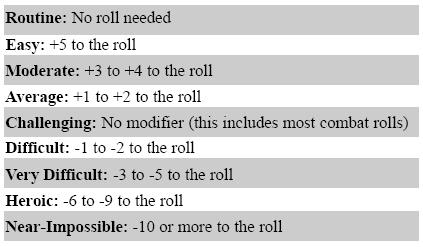
OUTCOME TABLE
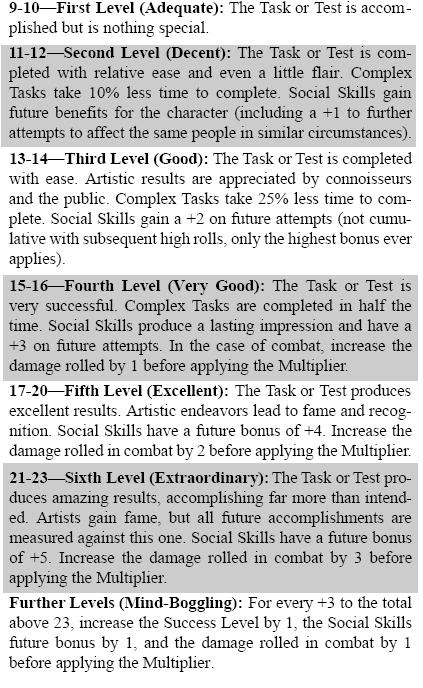
A result of 9 or more generally means that the attempt was accomplished, but sometimes the degree of that success is important. In such a case, take the final result (including all negative and positive modifiers) and consult the table below.
GETTING SCARED
In scary circumstances, mundane humans must pass a Difficult Willpower Test; Gifted use a Simple Willpower Test. If this Fear Test is failed, panic sets in. Like any other Test, modifiers may be applied at the Chronicler’s discretion. Once a character fails a Fear Test, use the Fear Table to determine results. Roll a D10 and subtract the character’s Willpower from the result. Then apply any Fear Test penalties as a bonus. So if the character had a -4 to her Fear Test, she would have a +4 when rolling on this table. If the final result is less than 9, the character was only scared for a few seconds. If it is more than 9, the Fear Table uses Success Levels to determine the effects fright has on the character. As with anything else, if the Chronicler feels the result is inappropriate, he can always change it to something else.
FEAR TABLE
3 - Combate
COMBAT
Combat is broken down into a series of actions called Turns. A Turn lasts one to five seconds of Game Time. At the beginning of each Turn, the players declare the intentions of their Cast Member. This is where they say, “I want to draw a gun,” or “I cast an Invocation.” The Chronicler decides if that action is possible in one Turn. Most simple actions are, but if a character wants to knock a hole in a wall with her gun butt, she is going to need more than five seconds.
Everyone then rolls Initiative on a D10 and adds their Dexterity. The Chronicler does the same, or simply decides when the Supporting Cast or Adversaries act.
Once initiative is determined, the intended Tasks and Tests are rolled. Usually, a character may only take one action per Turn. If she wishes to do more, each additional action suffers a cumulative -2 penalty. So the first action in a Turn is resolved normally, a second action taken in that same Turn incurs a -2, a third action incurs a -4, and so on. Close combat (fighting an opponent at arm’s length or closer) is a little bit different—one attack and one defense Task are allowed per Turn. Beyond that, the cumulative -2 penalty applies. In close combat, attacking is a Task using Dexterity and the appropriate skill (Brawling, Martial Arts, or Hand Weapon). If the target has a hand weapon, he may attempt to parry with a Dexterity and Hand Weapon Task. Characters with Martial Arts may attempt to parry a weapon with their bare hands.
Anyone may attempt to dodge an attack. If the character has the Dodge Skill, a Dexterity and Dodge Task is used. If he does not have that skill, a Difficult Dexterity Test is required. Attacking and defending are treated as Resisted Tasks.
Ranged attacks use a Dexterity and weapon skill Task with modifiers based on the range. Point blank range adds +1 to the strike Task and +1 to the Damage Multiplier. Short range has no modifier. Long range adds -3 to the strike Task and reduces the Damage Multiplier by one. Extreme range adds -6 to the strike Task and -2 to the Damage Multiplier. Ranged weapons list their ranges in yards, separated by slashes (for example, a shotgun with buckshot has a range of 10/30/50/100/200 yards).
Lighting can affect combat. Poor light (a dark alley or moonlight) gives a -1 to the combat Task. Bad lighting (a moonless night) gives a -4. Total darkness is a special case; roll a D10 and only a 9 or higher strikes the target. If the character makes a Difficult Perception Test, she can add the Success Level to the D10 roll. This signifies the use of other senses besides sight to hit the target.
Multiple shots are possible with ranged weapons. For each additional shot fired in a single Turn, the strike Task suffer a cumulative -1 penalty. All this gunfire can be pretty distracting. Anyone who is being fired upon must pass a Simple Willpower Test in order to carry out her stated intention. Otherwise, she freezes, hesitates, or huddles down in a corner and tries desperately not to be hit.
Damage is measured in Life Points. If the Life Points are reduced to 0, the character is critically injured and risks death. Most damage in the Unisystem is determined by rolling a die and multiplying the result by the Damage Multiplier. For instance a .22 pistol does D4 x 2(4). The 2 is the Multiplier; the number in parenthesis is the average result (used when the group wants to cut down on die rolls).
Damage is reduced by armor. The Armor Value (AV) is rolled (if necessary), and that much is subtracted from the damage inflicted. In the case of a bullet or slashing weapon, remaining damage is doubled.
THE EFFECTS OF INJURY
A character reduced to five Life Points (LPs) is seriously hurt. All actions have a negative modifier of anywhere from -1 to -5 (at Chronicler’s discretion). At zero LPs or below, the character is knocked down, stunned and semi-conscious. A Consciousness Test (Constitution and Willpower minus the number of LPs below zero) is required to remain conscious. So, at -7 LPs, a Consciousness Test suffers a -7. At - 10 LPs, a Survival Test is required (Constitution and Willpower minus 1 for every 10 LPs below zero). The Survival Test must be passed once each minute until the character receives some First Aid. Each additional Test is at a cumulative -1.
For example, Liz Rosen is shot twice by a 10mm for 50 points of damage. She had 22 LPs and is now at -28 LPs. Her Constitution is 2 and her Willpower is 2. This total of 4 is reduced by 2 (1 for every 10 points below zero) for her Survival Test. She needs to roll a 7 or better to live. If she lives, she must make a Consciousness Test to avoid passing out. This is at a -28, so unless she rolls a string of 10s, she is going to go unconscious. If she does not receive any kind of medical attention, a minute later she has to make another Survival Roll with a -1 penalty.
RECOVERY
First Aid stabilizes the patient (no more Survival Tests), and grants one Life Point per Success Level of an Intelligence and First Aid Task. Characters regain one Life Point per Constitution level per day until they reach zero Life Points, and two Life Points per day thereafter. Characters recover consciousness when their Life Points rise above zero.
OBJECTS
Objects have a Damage Capacity. The Damage Capacity is comparable to Life Points. Once that number is exhausted, the object is destroyed. The Chronicler decides whether a certain attack damages a certain object. For example, a man can pound on a car fender all day, but only damages himself.
Objects may also have an Armor Value (AV). This indicates how many points of damage are ignored before Damage Capacity is decreased.
ENDURANCE LOSS
Hard work (like running away from an angry mob) can reduce a character’s Endurance Pool by one every ten minutes. Very Hard Work reduces Endurance by D4(2) every minute. Frenzied Activity costs D4(2) Endurance every Turn.
Characters also need at least seven hours of sleep in a 24- hour period. For every hour missed, reduce Endurance Points by one. If the character stays awake longer than 24 hours, one Endurance Point is lost each hour beyond 24 in which she stays awake. Thus, a character that has been awake for 36 hours loses a total of 19 Endurance Points (7 for the first 24 hours, 12 for the next 12 hours). These points can only be regained by sleeping. Once Endurance Points drop to five or less, -2 is applied to all actions.
If the character gets below zero Endurance Points, she must pass a Consciousness Test (see Effects of Injury, p. 10) to stay awake. This Test must be passed every Turn, so eventually the character will pass out.
Characters recover one Endurance Point per Constitution level per half-hour of sleep, or hour of rest.
ESSENCE LOSS
A character’s Essence Pool may not be voluntarily brought below zero. Other effects may involuntarily reduce it below that level.
A character reduced to half her Essence Pool feels numb. All mental Tasks are performed at a -1 penalty until the Essence is regained.
At 1 or 0 Points of Essence, the character falls into a deep depression. All Tasks and Tests suffer a -3 penalty.
If Essence is reduced below 0, the victim must pass a Difficult Willpower Test with a -1 penalty for every 5 Points below 0. If failed, the character temporarily loses one level in one Mental Attribute.
If Essence is reduced to -30 or below, the character must pass a Survival Test (see Effects of Injury) with a -1 penalty for every 10 Points of Essence below 0.
Characters killed by loss of Essence have no apparent cause of death; medical examiners usually just call it heart failure. Normal humans regain one point of Essence per hour for each level of Willpower.
4 - Magia
MAGIC
To work magic, the Gifted must use Invocations—ritual actions and words that help focus the Magician’s will and imagination to produce the desired effects. All living things have an Essence Pool. Some among the Gifted have the power to tap into Essence at will; they are known as Channelers. A character’s level in Essence Channeling determines how much Essence he can bring forth from his inner reserve in one Turn.
All Invocations require three steps:
First, the Essence needed to create the effect is called forth—the Summoning. The Summoning takes as many Turns as are necessary to accumulate the Essence needed in the Invocation. If the Magician can channel all the Essence he needs in one Turn, he may perform the Focus Task on that same Turn.
Second, the Essence is then woven into a matrix (provided by the Invocation) designed to produce the desired effect—the Focus. A Focus roll is necessary, a Willpower and Invocation level Task. Targets can resist some Invocations; treat these as Resisted Tasks.
The third step—the Dismissal—requires no Task if the Focus Task was successful and no malicious intent was present. Using Soulfire to destroy a demonic monster is not malicious; using it to win a bar fight is. Otherwise, a separate Willpower and Invocation level Task is required. Dismissal Tasks have a base penalty of -1 for every five Essence Points spent (rounded up). If the Dismissal is successful, there are no further repercussions. Otherwise, Random Essence Effects occur.
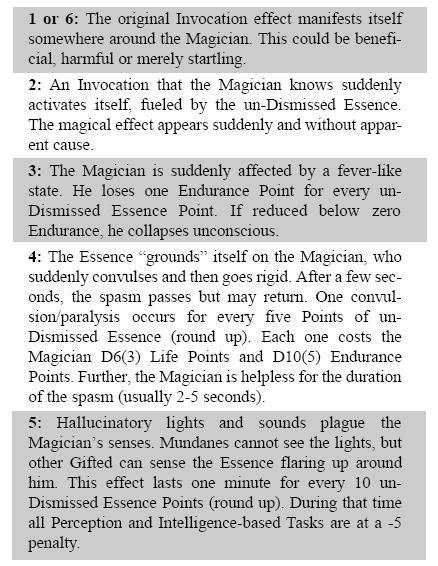
RANDOM EFFECTS TABLE
Random Essence Effects occur in the vicinity of the failing caster within 24 hours. The Chronicler can pick one of the entries on the chart below, or roll a D6 and apply the result.
USING ESSENCE DEFENSIVELY
Those with Essence Channeling may use Essence defensively with a Resisted Task. The attacker uses the result of his Focus, Seer Art or other supernatural ability Task. The defender uses D10 and his Willpower, and adds one for every point of Essence spent in the defensive maneuver. If the defender is reacting quickly, he is limited by the amount of Essence he can channel in one Turn. If the defender wins or ties, the metaphysical effect fizzles out before affecting him. Otherwise, the Invocation, Seer Power or other supernatural ability works normally. This defensive Task is used in addition to any normal Resisted Tasks or Tests that apply to the power.
THE CROWD EFFECT
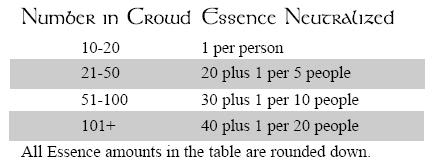
One of the reasons the Gifted seldom operate openly is that, when confronted in great numbers, mundanes and their emotions can overcome or dim the powers of Magic through the unwitting focus of their Essence. This occurs only during very specific circumstances.
First, at least ten people must be present; only groups of mundanes can generate enough power to seriously hinder a Magician. Second, the crowd must be aware that the Gifted is trying to perform magic, unless he is trying to affect members of the crowd with the magical effect, in which case the resistance is automatic. In other words, a Gifted character casting an Invocation without drawing attention to himself would be spared unless he was targeting the crowd itself. The amount of Essence neutralized varies by the size of the crowd (see the table below for the specifics)
CROWD EFFECT TABLE
SOURCES OF ESSENCE
Places of Power: Although Essence flows everywhere, there are areas where its currents run deeper and stronger. These Places of Power naturally accumulate Essence Points, which can be more easily tapped than ambient Essence. Any Invocation performed in such places can tap this extra power. The extra power can also be tapped by supernatural beings, some of which use it to manifest in the area. Haunts, evil spirits and strange occurrences often plague Places of Power. All Places of Power have an “overflow” of Essence that can be tapped by anyone performing Invocations in the area. This overflow renews itself every 24 hours, and it works on a “first come, first served” basis—after somebody exhausts the overflow, no extra Essence is available for the rest of the day.
Time of Power: Some times of the day, dates of the year and special events have a special significance. Noon and midnight are the most commonly occurring Times of Power. Any Invocation or supernatural ability performed during these hours (the benefits last for the entire hour) gains an additional five Essence Points. The Full Moon, the Summer and Winter Solstices, the Vernal and
Autumnal Equinoxes, and the Four Days of Power (Imbolc- February 2nd, Beltane-April 30th, Lughnasadh-August 1st, and Samhain-October 31st) all grant an additional 20 Essence Points. Times of Power are cumulative.
For example, a ritual conducted during the Vernal Equinox at midnight garners a total of 25 extra Essence Points.
Items of Power: Many symbols also have a great deal of power.A drawn or carved circle attracts an additional 10 Essence Points, useable in defensive Invocations only, for those inside it. A Circle also grants five extra Essence to those standing outside
the Circle, which can be used for any Invocation. The Pentagram, or five-pointed star, contributes five Essence Points to any Invocation cast within it. A Pentagram inside a Circle contributes a total of seven Essence Points, or 15 Points to any defensive Invocation.
GROUP MAGIC
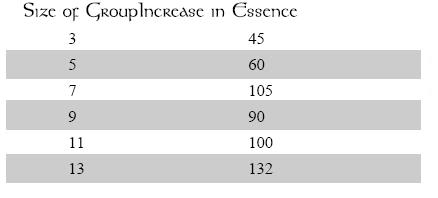
Sorcery is more effective when performed by a group. In the working of Magic, the most important numbers are 3, 5, 7, and 13. The numbers 9 and 11 have some power, but are less important. Gathering in these numbers allows the use of extra Essence Points. The extra Essence from each number is listed below.
GROUP ESSENCE TABLE
Usually the Magician most skilled at the Invocation(s) to be attempted becomes the Leader of the Circle. The basic steps in casting group Magic Invocations are the same as for normal Invocations—Summoning, Focus and Dismissal.
The only change is the contribution of the group to the process. Only characters with the Essence Channeling Quality can participate in a Circle.
During the Summoning, the members of the Circle all contribute Essence to the process. The participants can contribute as much Essence as they wish, limited only by how long the Circle’s Leader waits. Circle members who do not know the Invocation being attempted are less effective, however; because of their inability to visualize the specifics of the Invocation, every two Essence Points they contribute only count as one Essence Point. The process ends when the Leader has absorbed all available Essence, or when the Leader decides he has gathered enough power. The Leader takes the combined energy unto himself; this includes any “free” Essence generated because of the number of participants present. The Leader then makes a Focus Task as though casting the Invocation by himself. When a Dismissal Task is necessary, the Leader gains a +1 bonus per member of the Circle (including himself). These bonuses may only be used to offset the Dismissal penalties; they do not add to the Dismissal Task roll. This helps the Leader Dismiss the often-enormous energies gathered by the group’s efforts.
THE SIGHT
Since humankind gained self-awareness, some people have been blessed with senses and abilities beyond the physical. These powers have long been known as “the Sight” or “the Second Sight,” since many such abilities involve sensing or seeing things beyond the scope of the five senses. The Sight does not require rituals or Invocations, nor does it involve invoking outside forces to perform Tasks; the power is entirely internal.
SEER POWERS
Each Seer ability has two elements: Strength and Art. Strength represents the raw power the psychic has. Art represents the degree of expertise a psychic has in using his abilities.
SEERS AND ESSENCE
Characters with Essence Channeling can temporarily raise the Strength of any of their Seer Powers by spending Essence Points. Every two Essence Points spent raise the Strength of a power by one during its next use. Only the amount of Essence the character can channel for one Turn can be used to increase a Seer Power, however.
HOLY SYMBOLS
From ancient legends to modern Hollywood movies, the power of holy symbols is part and parcel of many stories about the supernatural. A character using a holy symbol (be it a Cross, an Ankh, or any similar object) to protect himself must pass a Simple Willpower Test. Each Success Level allows the character to focus one Essence Point through the holy symbol. Supernatural beings confronting the charged holy symbol must make a Difficult Willpower Test at a -1 penalty per Essence Point focused through the symbol, or feel pain and fear when faced with it. The creatures hesitate to come near the wielder, let alone attack him. Even if the monster does not flee the power of the symbol, all its actions suffer a -4 penalty.
5 - Armageddon (Setting)
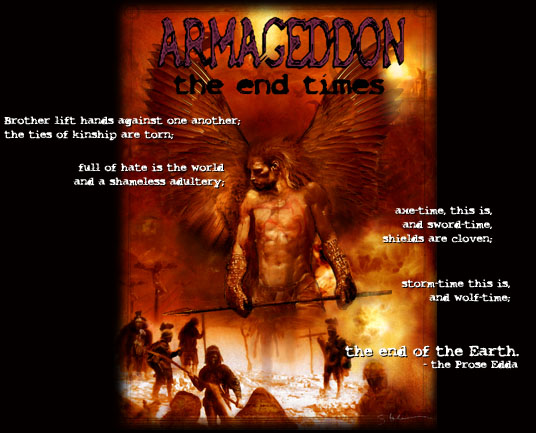
"Armageddon" decorre num futuro próximo, no mesmo setting the WitchCraft, onde ocorreram grandes mudanças. A Magia e o sobrenatural já não são parte de um mundo secreto, mantido escondido das massas. Em vez disso, uma guerra aberta entre a humanidade e as forças de estranhos e aterradores entidades de outra dimensão estende-se por todo o globo.
Anjos e os antigos Deuses caminham agora pela terra, lado a lado com os exércitos da humanidade, unidos contra Leviathan, uma criatura que ameaça a existência do universo inteiro. O Apóstolo das Trevas é o líder espiritual da Igreja das Revelações (aka "CoR" - Church of Revelations), um culto a nível mundial que venera Leviathan como se tratasse de um deus. Ele lidera também a força militar conhecida como o Exército das Revelações (Army of Revelations - AoR). Quer a Igreja quer o Exército fazem o trabalho de Leviathan na Terra. Assim que um número suficiente de seres humanos sigam Leviathan, ele poderá manifestar-se na nossa dimensão, refazendo o mundo à sua própria e retorcida imagem.
Felizmente, há forças ocultas a tentarem impedir isto a todo o custo; As Nações Unidas lideram o mundo livre contra as trevas dos Exércitos do Apóstolo na Ásia, em África, e nas Américas. A Europa está práticamente perdida, mas nela continuam a existir células de resistência, que continuam a lutar através de sabotagem e guerrilha contra o Exército das Revelações. A guerra extende-se, igualmente, pelos Otherworlds - nos Mundos da Morte, nos Reinos das Fae, e nos Domínios dos Deuses. Até os exércitos Celestiais e Infernais lutam unidos contra um inimigo comum.
Este é o mundo de Armageddon. Durante anos, a magia tem-se tornado mais poderosa, e as criaturas sobrenaturais têm-se tornado mais comuns, enquanto o mundo se prepara para a batalha final. Os jogadores podem escolher entre uma grande variedade de tipos de personagens, com diversos níveis de poder. Podem jogar de poderosas criaturas divinas, como os membros das Hostes Celestiais ou as Legiões Infernais. Podem jogar com servos sobrenaturais dos antigos deuses, compartilhando algum do poder destas divindades. Podem ser Imortais, que utilizam um vasto e olvidado conhecimento para proteger o mundo de um inimigo de quem têm ainda se lembram de um passado muito distante. Podem jogar como seres humanos de poderosas habilidades, a quem as suas longas vidas os conduziram até este conflito, ou mesmo seres humanos que apenas começaram a aperceber-se do seu potencial metafísico recentemente. Podem até ser soldados perfeitamente normais, lutando nas linhas da frente da batalha final.
Não importa como as personagens são retratadas, quem são, e se agem contrafeitos ou por escolha; todos eles trabalham com um único objectivo comum.
Salvar o mundo.