
 Eventos
 Tópicos Recentes
 Fórum
Fórum Classificados
 BoardGameGeek
 RPG Geek
2 - Regras

RULES
Roleplaying games are still games, and like most games they have rules. The main rule is for the Chronicler and the players to have fun. Rules are not necessary for many aspects of the game. Simple things like talking or picking up an object do not require rules. Only if the outcome of an action is in doubt and the results of that action are important, do the rules come into play. That’s when it’s time to start rolling dice.
The ten-sided die (D10) is the one most commonly used in the game; all Tasks and Tests are resolved with a D10. Basically, a player rolls a D10 and adds the appropriate Attribute and/or skill to the number rolled. If the result is 9 or higher, the action was successful. If it is less than 9, the action failed. A higher total value means a more spectacular success, and some actions may be more difficult than others (when modifiers are applied).
Most actions are considered Tasks; these add the values of one Attribute and one skill to a D10. The Chronicler always determines which Attribute and skill should be used for a particular action. Tests are used when there is no appropriate skill. There are two types of Tests:
In a Simple Test, the value of the Attribute is doubled and added to a D10.
In a Difficult Test, the value of the Attribute is not doubled before adding it to a D10.
The Chronicler determines which Attribute is used for the Test, and whether it is a Simple or a Difficult Test.
For example, Keith is playing Sonny Chang. Keith wants Chang to climb up the drainpipe of a three-story building. The Chronicler decides that this should be resolved with a Task using Chang’s Strength of 4 and Climbing Skill of 2. The player rolls a 4 on a D10, and adds 6 (the sum of Attribute 4 and Skill 2). The result is 10. Since this is higher than 9, Sonny Chang succeeds in making his way to the rooftop. The Chronicler then tells the player to roll a Simple Perception Test. Chang’s Perception is 3, so this is doubled to 6. A D10 is rolled and comes up 6, for a total of 12. The Chronicler informs the player that Chang cannot help but notice the sticks of dynamite bundled together on the rooftop and the small red display that is rapidly counting down to zero.
If a character does not have the appropriate skill, she may make an Unskilled Attempt. This uses the appropriate Attribute (without doubling it) with a minimum penalty of -2. Regardless of the outcome of the attempt, the Success Level is never more than Decent (see Outcome Table). For example, Zoe has no Driving Skill, but is behind the wheel of a car. She hits a patch of ice, and the car starts to spin. She rolls a D10 and adds her Dexterity with the -2 modifier to the roll. As her Dexterity is 3, only 1 is added to whatever comes up on the die. She had better roll something high.
Sometimes a character attempts something and another character tries to stop her or avoid the action. This is a Resisted Task or Test. It is resolved as a normal Task or Test, but both sides get to roll. If both rolls fail, neither side gets the desired effect. If one fails and one succeeds, the successful character wins. If both rolls are successful, the better result wins. Ties are rerolled.
THE ROLE OF LUCK
On an unmodified roll of 10, that result is added to the total. Further, the player rolls a D6 and subtracts 1. This number is also added to the total. If a 6 is rolled on the D6 (5 is added to the total), roll the D6 again. Continue until the D6 result is something other than a 6. Truly large numbers can be generated this way. On an unmodified roll of 1, nothing is added to the total. Again, a D6-1 is rolled, but this time the result is subtracted from the prior total. Again, repeat this process as long as 6 is the result of the additional rolls. This can result in very low negative numbers.
MODIFIERS
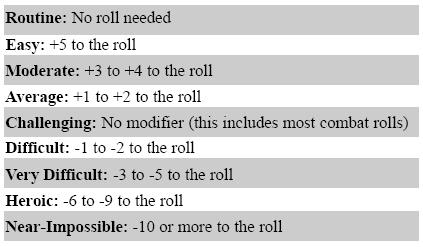
Sometimes circumstances make an attempted Task easier or more difficult. In such a case, a positive or negative modifier determined by the Chronicler may be added to the attempt. The following table shows some modifiers that may be used.
OUTCOME TABLE
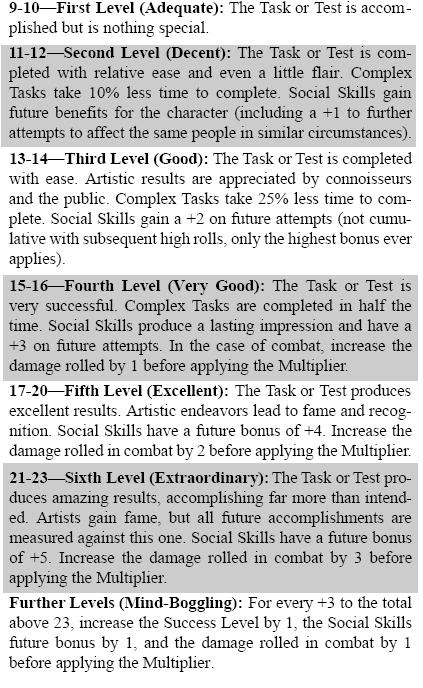
A result of 9 or more generally means that the attempt was accomplished, but sometimes the degree of that success is important. In such a case, take the final result (including all negative and positive modifiers) and consult the table below.
GETTING SCARED
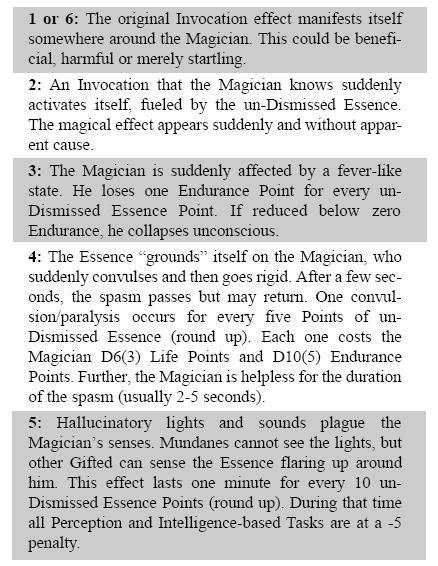
In scary circumstances, mundane humans must pass a Difficult Willpower Test; Gifted use a Simple Willpower Test. If this Fear Test is failed, panic sets in. Like any other Test, modifiers may be applied at the Chronicler’s discretion. Once a character fails a Fear Test, use the Fear Table to determine results. Roll a D10 and subtract the character’s Willpower from the result. Then apply any Fear Test penalties as a bonus. So if the character had a -4 to her Fear Test, she would have a +4 when rolling on this table. If the final result is less than 9, the character was only scared for a few seconds. If it is more than 9, the Fear Table uses Success Levels to determine the effects fright has on the character. As with anything else, if the Chronicler feels the result is inappropriate, he can always change it to something else.
FEAR TABLE
- Versão de impressão
- Clique Iniciar Sessão ou registar-se para colocar comentários
- 611 leituras