
 Eventos
 Tópicos Recentes
 Fórum
Fórum Classificados
 BoardGameGeek
 RPG Geek
 Ludopedia
BoardgameNews


BoardGameGeek features information related to the board gaming hobby
Actualizado: 1 hora 46 minutos atrás
Solitaire Sunday: You Got Chocolate Fix in My Minecraft Travel Magnetic Puzzle
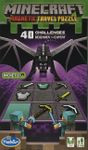
 This week's "Solitaire Sunday" is a twofer, mostly because the logic puzzles I'm covering — Chocolate Fix and Minecraft Travel Magnetic Puzzle — use the same engine underneath their hoods.
The concept is simple: Use the visual clues presented in one of the puzzle's forty challenges to place all nine objects — which come in three colors and three shapes — into the proper spaces in the 3x3 grid. The puzzle concept comes from Mark Engelberg, with the individual challenges being created by Serhiy Grabarchuk Jr. Here are two Minecraft examples of these challenges:
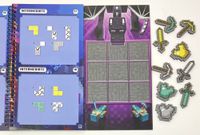
Both of these puzzles are labeled as being for ages 8+, and the challenges tend to skew simpler than I would have anticipated, but publisher ThinkFun has been in business for more than thirty years, so perhaps it has a better idea of what's appropriate for which ages than I do. For the most part, solving each puzzle from #1 to #30 took me only a couple of minutes at most, so if you're familiar with this type of puzzle, you might also race through them as quickly as I did.
That said, I've owned Chocolate Fix for probably ten years at this point, and I've run through its puzzles multiple times over the years, bringing it out (along with other logic puzzles) to challenge my son or an exchange student with something not quite like schoolwork that can ideally still provide a specific type of learning experience. As a result, when I received a review copy of Minecraft Travel Magnetic Puzzle, I already had a background rich in this type of puzzle solving, so I was primed to tackle these forty challenges.
I then broke out Chocolate Fix to solve all the challenges once again and was pleased to discover that while the concept is the same in both puzzles, the individual challenges are unique in both, so you're not re-purchasing the same challenges with a blocky coat of paint. The difference between the two puzzles is especially pronounced in the inclusion of "negative clues" in Minecraft, with these clues showing what cannot exist in the solution of a challenge. Here's an example:
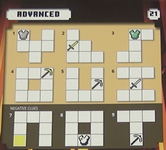 Note the YES, OUI, and NOT in the clues — clever!
ThinkFun plays up the "brain aerobics" aspect of these puzzles in its marketing copy, and while I think the science on such things is still out, I do feel it's valuable to learn how to connect the dots in an argument to draw a valid conclusion. These challenges present extremely artificial arguments, of course, but they still function in the same manner. Grabarchuk has designed the challenges so that as you start looking at the combination of clues in one of them, you see how you can deduce some definite element of the solution — and once you add that bit of information to the clues, you can then deduce something else.
Here's an example of a Chocolate Fix challenge that highlights how information get unlocked:
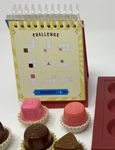
The two clues that show somewhat definitive locations of two of the pink chocolates let you know that the pink chocolate in the uppermost row will be the triangle since it's the only one that can be possible go in that row. Similarly, the two clues that somewhat lock down locations for two milk chocolates tell you which milk chocolate will be in the southwest corner — and knowing about that milk chocolate tells you where those aforementioned pink chocolates cannot be.
(Note that I bought this copy of the puzzle used, and the previous owner appears to have left some bits in the sun as the chocolates and "candy wrappers" no longer match in color. In later editions of this puzzle, ThinkFun used white, pink, and brown chocolates to avoid having two shades of brown. The publisher has also released a version with green (presumably mint) chocolate, and newer editions highlight that they contain "40 all new challenges", but I don't know whether these differ from the Minecraft puzzles or not. Someday PuzzleGeek will have all these answers, but that day is not today.)
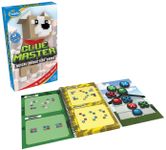
ThinkFun has also released a logic puzzle titled Clue Master from Engelberg and Grabarchuk, and the four puzzles depicted in the image above are included in Minecraft Travel Magnetic Puzzle, so perhaps they're all the same. More open questions!
For more about these puzzles, check out this video overview:
Youtube Video
https://www.thinkfun.com/products/clue-master/
Categorias: Notícias
A Report on the Games Scheduled to be Sold at Osaka Game Market 2020
by Saigo
 Editor's note: Game Market was scheduled to take place in Osaka on March 8, 2020, but wasn't held. Even so, Saigo — who translates game rules between Japanese and English and who tweets about new JP games — has translated a report about this non-event written by Takuya Ono, who runs the Table Games in the World blog. Mr. Ono has given permission to reprint the photos from his post. Many thanks to Saigo! —WEM
3月8日に開催予定だったゲームマーケット2020大阪は、新型コロナウィルスの感染防止のため中止となってしまった。そこで頒布されるはずだった新作ボードゲームは宙に浮いてしまったが、幸いにしてゲームマーケット公式をはじめいくつかのサイトが手を挙げ、ネット通販されるようになった。そのうちいくつかを見繕って遊んでみたレポートである。
--------------------
Game Market 2020 Osaka, which was due to take place on March 8, was cancelled to prevent coronavirus infection. Thus, the board games that were supposed to be released there lost that occasion, but fortunately, the Game Market Management Office and several other organizations offered to sell those games online. Here is my report on playing some of those games.
たぬきのきんたま(鳴海製作所娯楽部)
--------------------
Tanuki no Kintama (Tanuki's Balls) (from Narumi Factory)
カードをプレイして右の金玉と左の金玉を大きくしたり小さくしたりするカードゲーム。ゴーアウト系。
--------------------
Named after a famous phrase in the popular folk song "Tan Tan Tanuki", this is a go-out game to play cards and change the size of a Tanuki raccoon dog's left and right balls (called "Kintama" in Japanese).
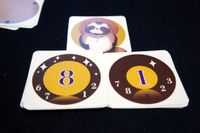
自分の手番には、場(ゴールンデンボールエリア)に手札からカードを1枚出す。出せるカードは場のカードより+2~-2で、出せなければ場札を1枚引き取る。左右が「1」と「8」になったら「一か八かボンバー」で、好きな人(もちろんトップ目)に山札からカードを1枚引かせることができる。
--------------------
The players take turns to play 1 ball card from their hand and place it on either left or right pile of ball cards in the ball area. You can play a card numbered within the range of ±2 from the topmost card on either pile. Otherwise, take the topmost card of a pile. If you manage to have the ball cards "1" and "8" in the ball area, it triggers the "1-8" (hit-or-miss) attack whereby you can make any one player (possibly the top player) draw a card from the deck.
数字は1~8があるが、1と8はつながっており、出せるカードの条件はそれほど厳しくないのでぶーらぶら(金玉だけに)と遊べる。
--------------------
The cards numbered "1" to "8" are used, and "1" and "8" are linked. The conditions to play the cards are not very strict, so you can play this game quite loosely like the loosely swinging balls of the Tanuki in the folk song.
DATA
ゲームデザイン&イラスト・なるみ
2~4人用、7歳以上、10~20分
--------------------
DATA
Game Design & Illustration: Narumi
2-4 players / Age: 7+ / 10-20 min
•••
The Field of the Sun(リトルフューチャー)
--------------------
The Field of the Sun (from Little Future)
ぼうずめくりの要領で山札からカードをめくり、作物のマジョリティーを競うカードゲーム。
--------------------
This is a card game in which the players take turns to flip cards from a communal deck of cards and compete for the majority of crops.
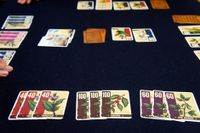
山札から1枚ずつめくっていって、好きなところでやめて、めくった中から1枚を取る。同じ作物の2枚目が出るとその作物しか取れない。山札がなくなったとき、作物の種類ごとに枚数がもっとも多いプレイヤーが得点、それ以外は失点。イベントを起こす特殊カードが3枚入っているが、ミニマムなシステムである。
--------------------
On your turn, flip cards from the deck one by one and add them to the single row. Stop at any point and take any one card from the row. If you flip a card of the same suit as one already present, your turn ends immediately and you must take the last flipped card. The game ends when the deck is exhausted, and the player with the most cards of each suit scores positive points for that suit while all other players score negative points. Even with three special event cards, the game system is very minimal.
作物は各種5枚ずつなので、3枚取れば必ず勝てる。しかしそううまくは集まらない。ほかの人が1枚持っているとき、同じ作物を取って競合するべきか否か、それとも競合を避けて別の作物を取るべきか。結局全部のカードが出てくるので、最後の最後まで気が抜けないドラマがある。
--------------------
There are five cards of each suit, so you can win the majority if you take three cards of a suit. However, you cannot collect them so easily. If another player has a card of the same suit, should you go for the same suit to compete with them, or avoid such competition and take a card of another suit? All the cards are eventually revealed, so the dynamic competition continues until the very end.
DATA
ゲームデザイン・エミユウスケ、イラスト・メメント森&山崎すはま
2~5人用、10歳以上、10~30分
--------------------
DATA
Game Design: Yusuke Emi / Illustration: Memento Mori & Suhama Yamazaki
2-5 players / Age: 10+ / 10-30 min
•••
おばけはおまえだ!(ギフトテンインダストリ)
--------------------
You Are The Ghost! (from GIFT10INDUSTRY)
聴覚を使ったコミュニケーションゲーム。イヤホンから流れる音で絵を選ぶ。ただし1人だけ、おばけ役の人がランダムに割り振られており、その人は同じ音を聞いた体でバレないようにしなければならない。
--------------------
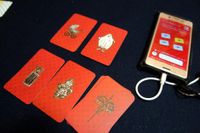
This is a communication game using hearing. The players take turns to choose a picture card according to the sound they hear from the earphone. One player, however, is randomly assigned to play the role of the ghost, and that player must pretend that they also heard the same sound to avoid being found out.
流れてくるのはおばけっぽい音。イヤホンを回して、スマホのボタンで音を出し、自分が聞いた音に合いそうな絵を取る。なんでその絵を選んだか簡単に説明して、その説明から怪しそうな人を一斉に指差し。バレなかったらおばけの得点、バレたら当てた人の得点になる。
--------------------
An eerie sound is heard from the earphone. The players take turns to receive the smartphone and earphone, press the button on the smartphone to play the sound, and take the picture that they think matches the sound. They each explain briefly why they chose that picture, then simultaneously point at a player who they suspect to be the ghost from the explanation. The ghost player gains points if they manage to trick others from finding them out, and other players each gain points if they find out who the ghost is.
具体的に言うとおばけ役が合わせやすくなるので、ほどほどにぼかすけれどもそうすると自分が怪しくなる。適当に言ったのがピッタリ当てはまったり、何も言ってないに等しいのにおばけでないことがうまく伝わったりして楽しい。
--------------------
Giving specific explanations helps the ghost player pretend that they also heard that sound, so the players explain the sound with some vagueness, but being too vague will make one look suspicious. It was fun playing the game, with occasions, such as the ghost player providing plausible explanations from a wild guess and a non-ghost player managing to communicate that they are not the ghost without almost any clear explanation.
DATA
ゲームデザイン・濱田隆史、イラスト・村瀬都思
3~6人用、10歳以上、15~30分
--------------------
DATA
Game Design: Takashi Hamada / Illustration: Toshi Murase
3-6 players / Age: 10+ / 15-30 min
English rules
•••
ツリーラインアベニュー(TACTICAL GAMES)
--------------------
The Tree-Lined Avenue (from TACTICAL GAMES)
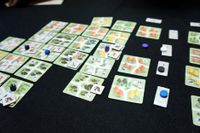
5種類の樹木を縦横に揃えて得点を競う。『キングドミノ』のボードが全員共通だったらどうなるか。
--------------------
The players compete to score by planting five types of trees in rows and columns. It is like, what would happen if a communal board is used for Kingdomino?
プレイヤー人数分の樹木カードを番号順に並べ、そこから1枚選んで6×6の公園ができるよう配置する。番号の大きいカードを取ると、次にカードを取る順番が遅くなる『キングドミノ』方式。ただし公園は全員共通で、自分の庭師コマを置いたところから縦と横の列にある樹木が得点になる。合従連衡して樹木を揃え得点を上げつつ、自分の庭師コマと関係のない列には邪魔な樹木を置いて得点を下げる。
--------------------
Tree cards are arranged in order according to the number of players. The players then take turns to choose one card and place it to eventually form a 6×6 grid park. The Kingdomino system whereby taking a higher-numbered card forces one to pick later in the next round is applied. However, on the communal park board, the players each score from the trees in the same rows and columns as their gardener pawns. The players play both cooperatively and competitively by arranging trees to score and at the same time planting obstructive trees on the rows and columns where their gardener pawns are not present.
公園には動物や施設もあり、ゲーム終了時ボーナスに絡むほか、番号の大きいカードにはお得なアクションが付いてくるものも。庭師コマは1人2個あり、合計4列で得点できることになるので、樹木はだいたいどれでも何とかなる。そのため手番順の変動が少なく、後ろに下がるとなかなか復帰できない。選択肢の多さが悩ましい。
--------------------
The park also has animals and facilities that are linked to end-of-game bonuses, and some high-number cards are equipped with advantageous actions. The players each have two gardener pawns to score from four lines in total, so most trees can be of some use. Because of this, there is little variation in the turn order, and it is difficult to move up in the turn order once you fall behind. The sheer number of choices requires a tactical handling.
DATA
ゲームデザイン・鈴木陽太&押切隼、ビジュアルデザイン・鈴木陽太
2~4人用、14歳以上、20~30分(2019秋新作)
--------------------
DATA
Game Design: Yota Suzuki & Hayato Oshikiri / Visual Design: Yota Suzuki
2-4 players / Age: 14+ / 20-30 min (released at TGM 2019 Autumn)
•••
タイムトラップ(TACTICAL GAMES)
--------------------
Time Trap (TACTICAL GAMES)
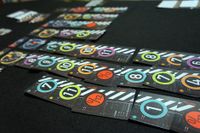
7ラウンドにわたってカードをプレイし、第7ラウンドで先に手札をなくすことを目指すカードゲーム。第6ラウンドまでに手札がなくなってしまうと脱落してしまう。
--------------------
In this card game, the players race to get rid of their hand of cards in the seventh round. If you run out of cards by the sixth round, you will be eliminated.
「奇数しか出せない」「何でも出せるが、5と7を出すとカードを奪われる」などラウンドごとに条件が設定されており、それに従って手札を昇順または降順にプレイしていく。最初に1枚ずつもっている「タイムトラップカード」をプレイすると昇順と降順が逆になる。出せるカードがなくなったらパスで、全員がパスしたら次のラウンドへ。
--------------------
There are different conditions for each round, such as "Play only odd numbers" and "Play any card, but if you play '5' or '7', your card will be snatched". The players play their cards in ascending or descending order in accordance with these conditions. At the start, the players each receive a "time trap" card that allows them to reverse the ascending/descending order. Pass if you do not have a card to play anymore. After everyone has passed, move to the next round.
第6ラウンドまでは脱落しないようカードをできるだけ温存したいが、ある程度減らしておかないと第7ラウンドで勝ち目がなくなる。ほかの人にどこまで出させるかも重要。気がついたときには負けている。
--------------------
While it is desirable to keep your hand of cards to avoid being eliminated by the sixth round, you must play and reduce them to some extent or else you will not be able to win in the seventh round. It is also important to assess how many cards you should make others play. Before you know it, you might lose at once.
DATA
ゲームデザイン・押切隼&鈴木陽太、ビジュアルデザイン・鈴木陽太
2~4人用、14歳以上、10~15分(2019秋新作)
--------------------
DATA
Game Design: Hayato Oshikiri & Yota Suzuki / Visual Design: Yota Suzuki
2-4 players / Age: 14+ / 10-15 min (released at TGM 2019 Autumn)
•••
インザルーイン(フダコマゲームズ)
--------------------
In the Ruin (Fudacoma Games)
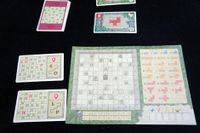
カードで指示されたパターンで通路や壁を書き込んで、古代遺跡からお宝を持ち帰るフリップ&ライトゲーム。
--------------------
This is a flip-and-write game to use the patterns indicated on revealed cards to write routes and walls in order to bring back treasures from ancient ruins.
各自自分のシートにカードで指示されたパターンで通路や壁を書き込んだら、カードに指示された数だけ、通路に沿って自分のコマを移動させる。お宝の場所はカードで指示され、全員共通だが早いもの勝ち。そこまで通路がつながっていないと、お宝があった場所は壁になってしまう。宝石が取られるとまた別のところに宝石が出現する。カードの山札がなくなったら前半終了で、後半は残った宝石を集めつつ、スタート地点まで戻って遺跡を脱出しなければならない。お宝のほかに、通路と壁が作られた四角形の広さの得点と、指定されたルートをつなげるともらえるボーナス、指定されたパターンが書き込めなかったペナルティーがある。
--------------------
After the players have each written the route or wall on their sheet in the pattern indicated on the card, they move their pawn the number of steps indicated on the card. The treasure locations are indicated on the cards, and they can be acquired on a first-come-first-served basis. If you fail to connect your route to the treasure, the treasure location will turn into a wall on your sheet. Each time a treasure is taken, another treasure will appear in another location. The first half of the game ends when the deck of cards runs out. In the second half, the players must return to the starting point to escape from the ruins while collecting the remaining treasures. In addition to the treasure, you can score by forming the largest rectangular area made of roads and walls, earn bonus points for connecting specified routes, and receive a penalty for failing to draw specified patterns.
フリップ&ライトゲームの常としてインタラクションは薄いが、「Bの宝取りました!」「あと1歩だったのにぃ!」というように宝を取ったときにお互いやっていることが分かる仕組み。暗中模索で探検している感じがある。
--------------------
As is frequently the case in a flip-and-write game, the interaction is relatively low, but the system allows the players to be informed of other players' actions each time a treasure is found, like "I've taken Treasure B!", "Oh, no! I was almost there!" The gameplay provides a feeling of exploring in the dark.
DATA
ゲームデザイン・沢口游佑、アートワーク・たかみまこと
1~4人用、8歳以上、30~45分(2019秋新作)
--------------------
DATA
Game Design: Yusuke Sawaguchi / Artwork: Makoto Takami
1-4 players / Age: 8+ / 30-45 min (released at TGM 2019 Autumn)
•••
[Editor's note: This Osaka 2020 title was covered separately on TGIW by Mr. Ono. —WEM]
海拓者(Kaitakusha - See Settlers)
--------------------
Kaitakusha (See Settlers)
迷走してもどの島に寄るか
--------------------
Choosing Which Islands to Visit Despite Going Out of Course
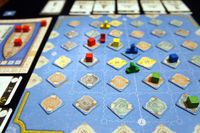
真っ直ぐには進めない船で島を巡り、建物を作りつつ向こう側を目指すボードゲーム。ゲームマーケット2020大阪で発表される予定だった作品で、関西のボードゲームカフェとプレイスペース付きショップ9店舗による「ボードゲームセレクション2020」で大賞に選ばれた。
--------------------
This is a board game to travel to your destination at the other side by a ship that cannot move forward, while visiting islands and constructing buildings along the way. This game, formerly due to be released at Osaka Game Market 2020, was selected as the grand prize winner of Board Game Selection 2020, a competition hosted by nine board game cafés and shops, where you could play the submitted games, in the Kansai region.
各自、自分の船をゲームボードの四辺からスタートさせる。自分の手番には、3枚の手札から1枚を出して船を移動させ、移動先の島で食料やカードなどを得た後、島に船員コマを置く。船員コマを置いた島はレンガ・鉄・石の資源が得られることになり、何手番か使って集めた資源で建設も行える。
--------------------
The players each start their ship from one of the four sides of the game board. On your turn, play a card from your hand of three cards for actions such as moving your ship; getting foods, cards and other items on the island you visit; and placing your crew member pawn on the island. Once you place your crew member pawn, you can get resources, such as bricks, iron, and stones, which can be collected over several turns and used for constructing buildings.
3枚の手札は前進がないだけでなく、同じカードが固まることもあって船は思いっきり迷走する。中央には得点チップがあるが、なかなかたどり着くことができないばかりでなく、たどり着いたとしてもほかのプレイヤーの船に囲まれ、脱出が難しい。しかもその中で、場札の建設カードに指示された資源をほかのプレイヤーより先に揃えなくてはならない。食料が不足すると船員が死ぬので、食料の調達も疎かにできない。
--------------------
The hand of three cards lacks forward movement. Furthermore, when ending up with the same type of card, your ship can go off course tremendously. There are scoring chips in the center, but not only is it difficult to reach there, but even if you do, you are quickly surrounded by other players' ships, making it difficult to move away from there. In addition, the players must race to get the resources indicated on the displayed construction cards. You also need to take care to procure food or else your crew members will die from a food shortage.
誰かがスタート地点の向かい側に到達するか、規定点に達したらゲーム終了。建設したカードの点数、種類によるボーナス、金塊や中央のタイル、到達したゴール地点の点数を加えて勝利点を競う。要素たっぷりで、どこに特化するかを手札と相談することになる。ほかのプレイヤーと狙いがかぶると得点が下がるが、手札のコントロールしにくさによって選択がライトになっている。
--------------------
The game ends when one of the players reaches the opposite side of their starting point or reaches the specified score. The players compete to score by adding up the points from construction cards, bonus points by type, gold and tiles in the center, and the points for reaching the goal. With so many elements, you need to examine your priorities according to your hand of cards. If your priorities coincide with another player, it will hamper your score, but such choice is made light due to the difficulty of handling your hand of cards.
4人プレイで45分ほど。中央付近で渋滞が起こり、空き待ちで膠着状態になったところを、bashiさんが遠回りしてゴール。遠回りする内に集めた資源も上手に使って建設の得点も積み増した。手札運は大きいが、だんだんできることが増えていく拡大の方向ではなく、いろいろな得点方法が用意されている多様化の方向によって、僅差で勝敗が最後まで分からないゲームである。
--------------------
Our game play with four players took approximately 45 minutes. A traffic jam occurred near the center, and while we waited for vacancies, Bashi-san reached their goal by making a detour. They also made good use of the resources they had gathered during the detour and managed to increase their points for construction. Despite the large element of luck in one's hand of cards, this game with diversified ways to score, instead of gradual engine-building, allows close competition by a narrow margin until the very end.
海拓者
ゲームデザイン&アートワーク・コヤマタダシ(2020年)
2~4人用/10歳以上/30~45分
--------------------
Kaitakusha (See Settlers)
Game Design & Artwork: Tadashi Koyama
2-4 players / Age: 10+ / 30-45 min
Categorias: Notícias
Build Prague in Medieval Times with Vladimír Suchý in Praga Caput Regni
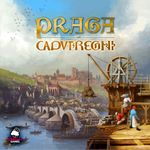 Czech publisher Delicious Games, which debuted in 2018 with Vladimír Suchý's Underwater Cities, will release a new title from the designer, one in which "its weight index will be higher than it was in case of other Vladimír's games", says Delicious' Katka Sucha.
Here's an overview of Praga Caput Regni, which is for 1-4 players, with a playing time of roughly thirty minutes per player:
Charles IV has been crowned King of Bohemia and ruler of the Holy Roman Empire. From his castle in Prague, he oversees construction of new fortifications: a bridge across the Vltava River, a university, and a cathedral rising within the walls of the castle itself. Prague is already among the largest cities in Europe. King Charles will make it the capital of an empire!
In Praga Caput Regni, players take the role of wealthy citizens who are organizing various building projects in medieval Prague. By expanding their wealth and joining in the construction, they gain favor with the king. Players choose from six actions on the game board — the "action crane" — that are always available, but which are weighted with a constantly shifting array of costs and benefits. By using these actions, you can increase your resources, improve the strength of your chosen actions, and build "New Prague City", the Charles Bridge, or city walls. You can possibly gain additional actions or even participate in the construction of St. Vitus Cathedral.
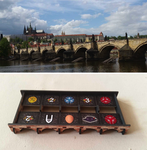 The Charles Bridge and its game-y equivalent
Clever players will discover synergies between carefully timed actions and the rewards from constructing civic projects as all of the mechanisms mesh together. At the end of the game, the player who most impressed King Charles wins.
Sucha notes that Vladimír Suchý was born in Prague, and with Praga Caput Regni he has fulfilled his longtime dream of designing a game that incorporates the city's long history. "The mechanisms are meant to invoke a number of 3D medieval historical sites and buildings that can still be admired here today", she writes.
Praga Caput Regni is intended to be a SPIEL '20 release, but in any case it will be released in Q4 2020.
Categorias: Notícias
Ticket to Ride Heads Back in Time to 17th Century Amsterdam
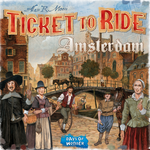 The Ticket to Ride train continues to roll on — although in the case of the newly announced Ticket to Ride: Amsterdam, players will be using transportation of a different sort as the game is set in 17th century Amsterdam instead of a more recent time. As the press release explains:
You are in the middle of the Gouden Eeuw, the Dutch Golden Age. Amsterdam is the beating heart of global trade and the wealthiest city on Earth. Goods from around the world are piling up on the docks, in ship holds, in warehouses, and on the banks of its countless canals. You mean to profit from this!
Ticket to Ride: Amsterdam, designed by Alan R. Moon and published by Days of Wonder, fits the model of 2018's Ticket to Ride: New York and 2019's Ticket to Ride: London, with the familiar gameplay from the Ticket to Ride game series — collect cards, claim routes, draw tickets — but on a scaled-down map with a scoring twist.
Here's an overview of this title, which is for 2-4 players with a playing time of 10-15 minutes:
Each player starts with a supply of 16 carts, two transportation cards in hand, and one or two trade contract tickets that show locations in the Amsterdam market. On a turn, you either draw two transportation cards from the deck or the display of five face-up cards (or you take one face-up wild card, which counts as all six colors in the game); or you claim a route on the board by discarding cards that match the color of the route being claimed (with any set of cards allowing you to claim a gray route); or you draw two trade contract tickets and keep at least one of them.
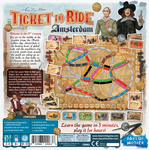
Whenever you complete a route that has carts depicted on it, with these primarily being on the perimeter of the city, you claim a merchandise bonus card.
Players take turns until someone has no more than two carts in their supply, then each player takes one final turn, including the player who triggered the end of the game. Players then sum their points, scoring points for the routes that they've claimed during the game, the trade contract tickets that they've completed (by connecting the two locations on a ticket by a continuous line of their carts), and their standing among those who hold merchandise bonus cards. Whoever holds the most cards collects 8 points, with other players collecting fewer points. You lose points for any uncompleted contract tickets, then whoever has the high score wins!
Ticket to Ride: Amsterdam is due out in Europe in July 2020 and in North America in September 2020, with a MSRP of $/€20. You download the complete rules from the Days of Wonder website.
Categorias: Notícias
Mercado de Lisboa: A Thinky Filler from Vital Lacerda?!
 The year 2020 continues to surprise me. Like most people, when I hear Vital Lacerda's name, I instantly think of heavy, thematic, brain-burn-inducing yet elegant games such as The Gallerist, Vinhos, Kanban, and (most recently) On Mars. Who knew the day would come that we'd see Vital Lacerda's name on a thinky filler game??
Well, my friends, that day has arrived. Julián Pombo and Vital Lacerda have teamed up to create Mercado de Lisboa — a quick-playing, easy-to-learn, deep and thinky tile-placement game for 2-4 players that Eagle-Gryphon Games plans to launch on Kickstarter in mid-2020.
Julián Pombo has worked with Lacerda as a developer and the main playtester on several of Lacerda's games: CO₂: Second Chance, Escape Plan, and most relevantly, Lisboa. As hinted in its title, Mercado de Lisboa is actually based on a mechanism in Lisboa, specifically the city-building system in which players pay money to own stalls on the market, with special stores next to them improving their profit and customer tiles that score for the matching booths.
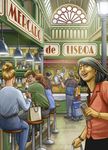 Cover art
In Mercado de Lisboa, players strategically place stand and restaurant tiles in the market (a 5x5 grid) to influence the price of goods sold at the stands, then place customer tiles at market entrances to sell those goods — all with the long-term goal of having the most money. Fish, flower, tomato, meat, and grape stands, for example, earn you more money when placed next to sushi bar, tea house, pizzeria, burger joint, and wine bar restaurant tiles respectively. Two pub restaurant tiles are included, and these are essentially wild since they'll earn any type of stand more money when placed next to it.
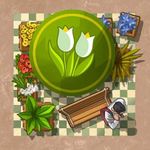
 Flower stand and tea house
During set-up, the game board is seeded with eleven restaurant tiles randomly drawn from a bag and placed face down (i.e., gray side up) on the marked spaces of the board. Each player receives three random stand tiles that they place face up in front of themselves, wooden stands of their player color, and 1 coin. The last player also starts with a pub restaurant tile. The left side of the board displays three stand tiles and three each of the four types of customer tiles (which show 1-4 customers).
Before starting, players decide whether to play with hidden or open money. From talking to Vital, Mercado de Lisboa was designed to be played with hidden money, but I think they wanted to give the option since some players may prefer playing one way or the other. I've played both ways, and it plays well either way, but at this point I prefer hidden money because most of the games I've played have been so close that it becomes an exciting reveal at the end of the game when you don't know exactly how much money your opponents have.
In Mercado de Lisboa, players take one of the following four actions on their turn, with players taking turns in clockwise order until someone triggers one of the endgame conditions:
(1) Open a stand
(2) Open a restaurant
(3) Bring customers
(4) Take 1 coin
• When you open a stand, you choose one of the three stand tiles in front of you with your color wooden stand and place it on a space that is empty or that has a face-down restaurant tile in the market. The cost of placing a stand is 1 coin for each stand in the row or column, including the one you are placing. (You pay the more expensive cost, so your stand creates a column holding two stands and a row holding three stands, you pay 3 coins.) After placing a stand tile, grab a new one from the designated area on the left side of the board so that you always have three from which to choose when taking this action.
It's important to note that whenever you place a stand or restaurant tile on a space with a face-down restaurant tile, you take that restaurant tile and place it face up in front of you with your available stands. You can place this restaurant on a future turn to earn 1 coin, but if you have any restaurant tiles in front of you when the game ends, you must pay 1 coin for each, so restaurant hoarding is not encouraged!
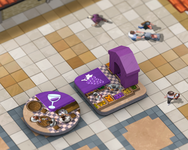
• When you open a restaurant, you place one of the restaurant tiles in front of you on a space that is empty or that has a face-down restaurant tile; this earns you 1 coin. Again, if you place a restaurant tile on a space with a face-down restaurant tile, you take that restaurant tile into your supply.
• While you can earn coins via restaurants, to make real money you need to bring customers. To do this, take one of the customer tiles on display and place it on an open market entrance space following two conditions: 1) You can place customer tiles at market entrances only where the number of customers is greater than or equal to the number of stands in the row (or column), and 2) at least one of your stands in that row must match one of the types of goods depicted on the customer tile.
After placing the tile, check to see which players earn money by having a stand in that row that matches a good on the newly placed customer tile. Count 1 for each of your matching stands, plus 1 for each matching restaurant orthogonally adjacent to your stand, e.g., a fish stand next to a sushi bar restaurant, then multiply that number by the number of customers on the customer tile, then take that many coins from the reserve. Don't forget those awesome pub restaurant tiles! They will boost your profit when orthogonally adjacent to any type of stand.
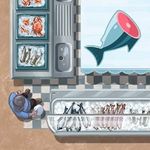
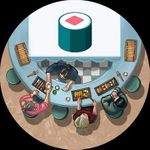 Fish stand and sushi bar
If you play your tiles right, you can take advantage of existing customers in the row and column of the new stand you place. Once customer tiles have been placed, you can get a discount or even possibly earn money when placing a new stand tile if this stand meets the demand of existing customer tiles. Needless to say, this is where Mercado de Lisboa really shines. When you place stand and restaurant tiles, you can set yourself up for profitable combos and start making some serious coin! Of course one of your opponents might beat you to the punch by placing an unfavorable customer tile where you were hoping to score big different customers. The game becomes sort of a race to place tiles at the right place and right time, with you hoping opponents don't place tiles to hinder your plans. It can feel tense, but in a light playful way, not stressful.
• If you have no better option or just need cash, you can take 1 coin. I haven't done this yet in the games I've played, but I've seen other players do it here and there. Considering that you can earn money by placing restaurant and customer tiles — and sometimes even stand tiles — I don't think this is ever an efficient action, but I understand why it's needed.
The end of the game is triggered when someone places a stand or restaurant tile that leaves only four market spaces open or a customer tile that leaves only four market entrance spaces open. This player does not get another turn, but all other players do. Once all players have taken their final turn, add up your coins, then subtract 1 for each unopened restaurant you have. Whoever has the most money wins!
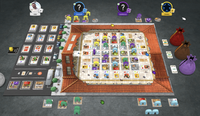 My 2 May 2020 game on Tabletopia
I've played five games of Mercado de Lisboa so far and have been thoroughly enjoying its unique blend of lightness with depth. This game is definitely thinky, but it's not meant to be overthunk. The actions are straightforward, and the whole game can be taught in five minutes and played in thirty. Turns are quick, and in my experience each game has felt distinctly different, which I find refreshing and challenging.
While you'll develop certain strategies with experience, you must be prepared to re-adapt based on the board state and how your opponents are playing. There's also the "fun" struggle of placing stand tiles when you need to grab a particular restaurant tile from the board, but placing your stand in that position isn't optimal because it's either too expensive or not where you need it to be to set up some other combo — or the even more "fun" struggle of trying to place the right customer tiles to minimize your opponents' profits while maximizing your own. I'm a fan of these challenges and struggles as it results in a satisfying gaming experience in which all players are watching the board intensely the entire game. Definitely no multiplayer solitaire here.
While I've played Kanban, Vinhos, The Gallerist, and On Mars, I've yet to play Lisboa, which I know is a lot of people's favorite Lacerda game. Trust me, it's on my list. I'm secretly hoping that my understanding of Mercado de Lisboa becomes a stepping stone for easing me into Lisboa. From what I've heard, that was part of the goal for making it. Either way, I'm looking forward to playing more Mercado de Lisboa. It's been great playing with people around the world on Tabletopia. and I imagine it'll be even better playing the physical version face-to-face with my opponents.
Categorias: Notícias
Blue Skies Ahead for Joe Huber and Rio Grande Games
 In 2019, U.S., publisher Rio Grande Games released the delightfully old-school game Caravan from designer Joe Huber (read my overview here), and now Huber and Rio Grande are partnering again for another classic-feeling game: Blue Skies.
The setting for Blue Skies is the late 1970s. With the United States having passed the Airline Deregulation Act in 1978, the federal government had opened the national airline industry to competition, with airlines now able to determine their own fares and routes. What's more, new airlines could enter the market more easily, and you represent one of those new airlines, a fresh face that needs to establish itself quickly and (more importantly) profit off customer demand for service — but with an entire country open to you, where do you set up shop?
Based on a reading of the rules, here's a fairly thorough overview of this game, which is for 2-5 players, is due out in July/August 2020, and bears a playing time of 45 minutes.
In Blue Skies, the game board presents players with thirty airports in thirty cities. Each airport has four gates, with you using 2-4 gates depending on the number of players. To set up, draw airport demand cards from the deck to seed airports with passengers. Whenever you place passengers on the board, draw from a bag that initially contains 100 red cubes and 25 green cubes; for each airport, continue drawing until you draw a red cube, then redistribute passengers at the open gates of that airport as evenly as possible.
(Note that at most the first five airports drawn will have an open gate, and even those will start with only one open gate run by a local airline. All of the other passengers are just bunched up at the gate waiting for you to serve them!)
Each player starts with three demand cards in hand, and they take turns choosing two gates with a purchase price of at most $6. Players adjust their income from $0, with their income being set to equal the number of passengers now waiting at their gates, then the game begins.
On a turn, each player in turn buys new gates at airports of their choice, spending at most $6 and banking any unspent money as points. You can buy out a local airline, set up gates in new cities, or purchase multiple gates in the same airport to try to dominate that area.
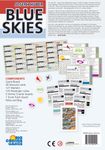 Back cover
Each player in turn then plays a demand card from their hand, drawing passengers form the bag to place one or more passengers at that location. Then demand cards equal to the number of players are drawn, and more passengers are ahead to those airports. The game board lists the number of cards for each airport, so you somewhat know the odds of where passengers might arrive.
Players adjust their income to account for the opening of new gates, the redistribution of existing passengers, and the arrival of new passengers, then they add their income to their score. If a player now has at least 100 points or has placed their twentieth and final gate, the game ends immediately; otherwise, you add a local airline gate to each airport with passengers but no open gates, pass the first player marker, then start a new round.
At game's end, score the seven regions of the United States based on the player's dominance of those regions. Each airport has a scoring value, e.g., ORD is worth 4, and each gate you have in Chicago is worth 4 for determining dominance in both the Midwest region and the Central region. (ORD is one of four airports in two regions, with the others being JFK, LAX, and DFW.) If you have the most dominance in the Central region, you score 13 points, whereas second place is worth only 6 points. Whoever has the most points wins.
I've skipped a few details along the way, but this description should still give you a sense of what the game is like, with the airports being akin to stocks in which you purchase shares based on both the limited information you hold and the public odds known to all, topped with an area-majority element that represents you becoming the airline of choice — or no other choice! — within a particular part of the United States.
Categorias: Notícias
Force Your Way to the Center of the Universe in Talisman: Star Wars
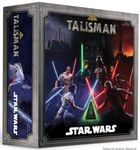 May the 4th is almost over for 2020 (at least here on the U.S. East coast), but before we start posting about Star Wars slightly less for the next twelve months than we usually post about Star Wars, let's close with an on-topic game announcement from publisher The Op.
Here's an overview of Talisman: Star Wars, another game created thanks to an ongoing partnership between The Op and Games Workshop, a partnership that has also brought about the release of Talisman: Batman – Super-Villains Edition, Talisman: Kingdom Hearts, and Monopoly: Warhammer 40,000:
Explore the Star Wars galaxy through memorable characters, places, and events from every era within the setting of a critically-acclaimed tabletop game franchise.
Talisman: Star Wars allows players to compete in a circuitous race to reach Emperor Palpatine, collecting items of power along the way to confront the all-powerful Sith Lord or stand beside him as an evil apprentice!
Adventurers can choose from twelve playable characters to charge their way into the inner rings of the galactic game board. Luke Skywalker, Darth Vader, Rey, Kylo Ren, Count Dooku, and Obi-Wan Kenobi are among the custom-sculpted game pieces true to every beloved Talisman game.
Talisman: Star Wars retails for US$60, and it will be available solely in European, Middle Eastern, and African regions, similar to how The Op released Star Wars: Dark Side Rising in 2019. Just in case this restriction was unclear, the press release also states this: "This game will not be available in North America at any time."
Categorias: Notícias
Game Overview: Hues and Cues, or Interpret the Rainbow
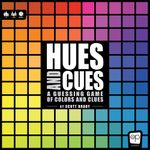 Covering a party game might seem strange at this time given the stay-at-home orders that are keeping many people from gathering to play, but Hues and Cues from Scott Brady and The Op is a party game for 3-10 players, so we could still get it to the table in our household.
The concept is simple: On your turn as active player, look at one of the game cards that depicts four colors from the 480 colored squares in the grid and choose one of those colors. (The co-ordinates for each color are included on the card.) Give players a one-word clue that corresponds to that color, avoiding simple color words (red, yellow, etc.) and anything in the playing area that people could see and therefore easily reference visually.
Each player in clockwise order places one of their two pawns on the board in an unoccupied space. You then give a two-word clue to your color or a different one-word clue. In counterclockwise order, players place their second token, then you place the "scoring box" on the game board centered on the chosen color and award points. If a player guessed the color exactly, they score three points; if they were within one space, two points; and if they were within two spaces, one point.
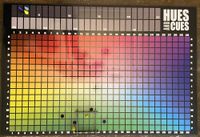
In the image above, yellow scores 3 points, while black and purple each score 1 point. You as the clue giver — or "cue giver" in the game's terminology — score 1 point for each pawn in the box. Each player serves as cue giver one to three times depending on the number of players, and whoever scores the most points wins.
I've played Hues and Cues five times on a review copy from The Op, twice with three players and thrice with four, and I preferred having a larger player count as you had more competition on the game board and more times to guess! Of course you could simply play more rounds if you want more guessing, or you could play to a certain point total as long as all players had the same number of turns.
 Terrible guessers — or terrible cue giver?
We played with the normal rules a couple of times, but we also experimented with storytelling and poetic clues, so instead of saying only "Pumpkin", we'd say, "Last week I went to pick up a box at the old house that had been mailed there by mistake, and the new owners still had a pumpkin on their porch. A soft, clearly rotting pumpkin, but a pumpkin nonetheless. What color is that pumpkin?"
I understand the challenge of the game being to convey or suggest colors with few words, and my story isn't much more than saying "Pumpkin" in a slightly longer manner, but we all enjoyed being able to add nuance to the short clues. Aside from that, we'd often use our second clue to further embellish the story — or we'd use our clues to continue the story told by the previous player: "Lisa got so excited by that giraffe she saw that she decided to make a cake to celebrate it, but she mistakenly added pomegranate juice to the icing mix, so the cake wasn't the color she had expected."
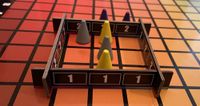 So much better!
Designer Scott Brady commented on my video overview of the game and said that storytelling has often been present in how people approach the game:
We also experimented with categories (only name Marvel characters, etc.) and it is a lot of fun to play that way as long as all players have a good knowledge of the subject. Some of the categories we found most fun are cartoon characters, logos (brands), sports teams, school colors and believe it or not, automobiles. (People are fanatics about what color that old Ford was.) We also experienced players trying to call out Pantone colors when it was groups of graphic designers!
I also appreciated the storytelling as my brain had trouble bringing up suggestions for a color in a single word, reverting to foods over and over again. (Similarly, I can't recall the colors of the rooms in my house outside of the hallway connecting the bedrooms; I just looked in the kitchen and was surprised to find it the same color as the living room.) With storytelling, I can make something up more easily, and I get to enjoy what others have created outside of — or rather in partnership with — the game experience, an aspect that Hues and Cues shares with many fine party games.
For more thoughts on the game, check out this overview video:
Youtube Video
Categorias: Notícias
Solitaire Sunday: IQ Twist, or Packing the Plastic Suitcase
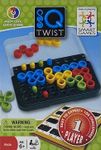 In a way, this write-up and video covers one title in the IQ line of logic puzzles from Belgian publisher Smart Toys and Games — specifically IQ Twist from in-house designer Raf Peeters — and in another way I cover the entire series.
The IQ line from Smart consists of nine titles that follow a similar format: You, the solver, are presented with a bunch of components, and you must fit them all in the accompanying grid or complete a particular pattern with them after placing the starting elements in the grid based on whichever of the 120 included challenges you've selected. Here's challenge #36 in IQ Twist:
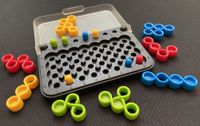
Here, the red peg must be enveloped by a red piece, the blue by a blue, and the yellow by a yellow. All of the pieces have at least one hole in them, and those holes can either be empty or filled with a peg of the matching color. Following that one guideline, you need to fit all of these pieces into the grid.
For this challenge, you know that the blue piece closest to the camera can't fit on the blue peg since the hole is not at the end of the piece. Similarly, the red "S" piece doesn't have a hole at the end, so you need to use the other red piece. That's all the info you have to work with until you start fiddling with the pieces, and as is the case with all of the challenges in IQ Twist, this challenge has a unique solution.
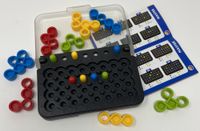 Challenge #78 — what's the starting point?
All of the IQ titles are similar in how they function. I bought IQ Twist used, and I've also solved challenges in IQ Blox, IQ Focus, and IQ Fit. The included book of 120 challenges gives you a lot to solve — with me typically fiddling with one of these on the fold-down tray in an airplane given that the plastic carrying case is the size of a double-thick smartphone, so it fits easily in my carry bag — but the challenges are also pretty same-y after you do ten or twenty of them. No matter how much you enjoy that pasta-and-sauce dish, if you don't mix up the meal with bread, salad, pine nuts as a topping, or something to provide variety, you're going to get your fill sooner than you think.
Comments on my coverage of logic puzzles often complain about the prize-to-challenge ratio of them, so in that regard IQ titles give you more for your money than anything else, but you're unlikely to blitz through them — or even remember where you stopped unless you leave the pegs in place when you pack it away. With these IQ puzzles, I'll usually solve a dozen or so, then put the box away to do something else until I'm waiting for my connecting flight. You get a little puzzle hit, then move on, coming back for more later once you need another mental twist...
To see this puzzle in action, check out the video below:
Youtube Video
Categorias: Notícias
COVID-19 at the Gaming Table IX: Expansions for Carcassonne, Hadara, and Deep Blue; UK Games Expo 2020 Is Off
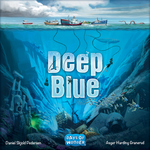 • Not all of the material covered in posts like these was made specifically in response to the COVID-19 virus, but since many people are not able to meet with their regular game groups, this feels like a good place to highlight such material, such as "The Captain Returns" scenario that designers Daniel Skjold Pedersen and Asger Harding Granerud have created for their 2019 Days of Wonder release Deep Blue.
Pedersen tells me that the goal was to make this scenario playable without the need for additional components: "We have been working on the scenario since last December, so that decision is not related to Covid-19, but I am the more happier with it now that a lot of people are stuck at home without access to printing facilities."
"The Captain Returns" is a scenario for 1-3 players that you can download from the BGG game page. Says Pedersen, "I have taken a lot of inspiration from my fellow Dane Morten Monrad Pedersen and his team's Automa work over the years. Morten always talks about creating bots that push up against you in key interaction points. In Deep Blue, those interactions are happening on the market row of cards where the Captain will remove cards from play and add gems to the bag, and they are happening racing for scouting spots on dive sites and the initiative to dive."
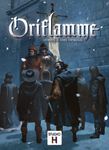
 • Somewhat similarly, Studio H has released two-player rules for the 2020 French game of the year Oriflamme that you can download from the BGG game page in English and French.
• Swiss publisher Helvetiq has followed its COVID-19 version of Bandido (covered here) with a print-and-play version of its 2016 trivia game Wine IQ.
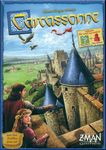 • German publisher Hans im Glück has released print-and-play expansions for two games.
In Carcassonne: The Land Surveyors, available for download here in English and German, surveyors roam the land, changing the value of roads, cities, and monasteries when they're scored.
More specifically, you'll create a stack of surveyor tiles for each of these three landscape features, with one tile being active for each feature and one tile being the next in line. When at least one feature scores points for any player, you resolve everything based on the currently active tiles, then you place those tiles on the bottom of their stacks, making the next-in-tile of each type the active tile. Some tiles give you bonuses, others penalties, so time the scoring carefully while the surveyors are on your side!
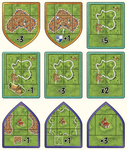
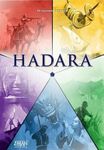 • With the timely Hadara: The Plague Doctors, downloadable in English and German here, each player gets access to two doctors who bring things both good and bad to your world.
After the "carving of a statue" action in phase A, you can choose to take the doctor of the matching Epoch, I or II, and place it on a color of your choice on your game board, regardless of whether you have cards of that color or not. For the remainder of the game, you cannot add cards of the plague-stricken color to your board. The plague doctor in Epoch I is worth 12 VP, while the one in Epoch II is worth 8 VP on its own or 13 VP if you have both doctors.
 • In late March 2020, UK Games Expo moved its 2020 show from May 29-31 to August 21-23 — but now the 2020 show has been cancelled for good, with the next UKGE taking place in 2021. Here's an excerpt from the announcement:
Since making that announcement we have been monitoring the situation with regard to the current Covid-19 virus pandemic. After long deliberation and with great reluctance, the directors of UK Games Expo have decided to cancel the 2020 UK Games Expo. This decision has been made after considering national advice and government directives with regard to the Covid-19 virus pandemic, the expected closure of large venues and the probable duration of the infection. We reached our conclusions following consultation with sponsors, show partners and our venues.
We consider that a cancellation at this stage maximises the chances to both protect the health and well-being of all our attendees but also the financial viability of our exhibitors and the UK Games Expo itself and gives the best opportunity for attendees to recover any secondary costs. This allows us the best opportunity to hold a successful show in 2021.
Categorias: Notícias
New Game Round-up: Revolt Against Caesar, Roll for Railroads, and Rip Through Opponents Like a Bullet♥︎
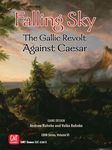 • French publisher ASYNCRON games has a partnership with GMT Games to release several titles from its catalog, particularly the COIN series of games, and its next release will be Falling Sky: Le Révolte des Gaulois Contre Caesar, with this being a combined version of Falling Sky: The Gallic Revolt Against Caesar and its Ariovistus expansion from Volko Ruhnke and Andrew Ruhnke, with this title becoming available for preorders on May 1, 2020.
Here's an overview of the game's setting and gameplay:
Late Summer, 54 BC: In a series of brilliant and brutal campaigns, Caesar has seized Gaul for Rome. But not all tribes rest subdued. In the north, the Belgic leader Ambiorix springs a trap on unwary legions while Caesar is away. In the south, an ambitious son of the Arverni seeks to unite a Celtic confederation in revolt against the hated Romans. And what of the influential Aedui? Their republic appears content to shelter under Roman protection – but can they be trusted any further than any other Gauls? Meanwhile, along the Rhine, Germanic warbands multiply...
Falling Sky: The Gallic Revolt Against Caesar takes 1 to 4 players into the military actions and complex politics of Roman-occupied but not-yet-conquered Gaul. Caesar and his hard-hitting legions cannot be everywhere and will not triumph without powerful allies among local tribes. But each Gallic confederation has its own agenda and must keep its eyes not only on the Romans but also on Celtic, Belgic, and Germanic rivals. Players recruit forces, rally allies, husband resources for war, and balance dispersed action with the effectiveness and risk of concentrated battle.
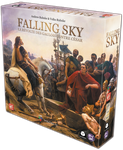
Leveraging GMT's popular COIN Series system to integrate historical events with wide-ranging strategic options across the game board, Falling Sky provides accessible and deep historical gaming of war, politics, and diplomacy. A full solitaire system enables solo players to test their skill against an array of game-run factions, each unique. From Britannia to the Rhenus and down to Provincia, armies are on the move. Who shall finally subdue Gaul?
• U.S. publisher Level 99 Games specializes in dynamic fighting games, and its next release along these lines is Bullet♥︎, a 1-4 player game from Joshua Van Laningham that plays in 10-20 minutes and that will be on Kickstarter in May 2020. Here's an overview of the game:
In Bullet♥︎, players take on the role of heroines in a far-flung future Earth and use their incredible powers to defend the Earth from evil — as well as from one another! Each heroine's powers manifest in a different form, with players controlling sound, paper, technology, gravity, triangles, and more!
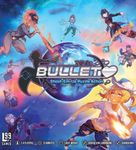
Bullet♥︎ includes eight characters to play and four game modes:
—Battle Royale Mode: 2–4 players can duel in a free-for-all puzzle battle that plays in real-time!
—Boss Battle Mode: 1–4 players can combine forces to survive against a single boss; the game includes eight bosses, one corresponding to each heroine.
—Score Attack Mode: A lone player can play for a high score against increasingly difficult odds.
—Team Battle Mode: Two teams of two players battle it out! The last team standing wins.
• Aside from that, Level 99 Games is relaunching BattleCON, the game with which the company started in 2010, with its fourth edition in 2020, with remastered editions of Devastation, Trials, Wanderers, and fourteen solo fighter decks available for preorder and due out in August 2020.
 • In 2018, Italian publisher Horrible Guild (then known as Horrible Games) released a pair of roll-and-write games from Hjalmar Hach and Lorenzo Silva — Railroad Ink: Deep Blue and Railroad Ink: Blazing Red. In these games, each round one player would roll dice, then everyone would use these dice to create networks of roads and train tracks, trying to create long paths while connecting multiple exits on their individual game boards. (You can watch a more detailed overview here.)
Now Horrible Guild plans to release two new titles in this line — Railroad Ink Challenge: Shining Yellow Edition and Railroad Ink Challenge: Lush Green Edition — with these titles being similar to the earlier releases, but not exactly the same. A Kickstarter campaign for these games will go live in May 2020, but for now you can read the following for an overview:
Railroad Ink Challenge is a quick-playing roll-and-write game for 1 to 4 players. Grab a board and a dry-erase marker, and get ready to reach networking nirvana! Roll the dice and draw the routes to connect the exits around your board. Expand your network with railways, highways and stations to collect points, but you will be penalized for any open connections, so plan carefully!
Railroad Ink Challenge has everything you love from the original Railroad Ink games and a lot more, with an all-new focus on player interaction thanks to in-game goals! Only those who achieve them first get the reward, so you have to keep an eye on what your opponents are doing and try to complete the goals before they do! A different set of goals is available each time, so no two games will be the same!

But wait, there's more! Draw unprecedented, mind-bending route configurations thanks to the new dice! Connect special structures to your network to trigger new effects: factories allow you to duplicate a die, villages give bonus points if they are close to a station, universities unlock extra special routes — use these effects wisely and you'll score big!
Railroad Ink Challenge comes in two versions, each one including one expansion with an additional dice set that adds new special rules to your games. Use oases to protect your cacti from the arid desert climate in the Shining Yellow Edition, and create placid forest landscapes and build into a beautiful arboreal paradise with the Lush Green Edition.
Categorias: Notícias
"New" Game Round-up: Sequels and Second Editions for Sidereal Confluence, Reef, Marco Polo, The King is Dead, and Sheriff of Nottingham
 Sequels and second editions continue to be a trend in the world of board gaming. Fortunately, they are generally favored and considered improvements more often than not — you know, more Terminator 2: Judgment Day than Poltergeist II: The Other Side. Here are a few available for preordering that might be worth checking out:
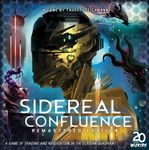
• The tuned-up, "Remastered" edition of TauCeti Deichmann's sci-fi trading and negotiation sensation, Sidereal Confluence, is coming from WizKids in late May 2020. In Sidereal Confluence, 4-9 players represent unique, asymmetrical alien races simultaneously trading and negotiating with each other to acquire resources necessary to fund their economy, produce goods, and (ultimately) score the most victory points. In more detail:
Each player chooses one of the nine unique and asymmetrical alien races that have come together to form a trade federation in their quadrant. Each race has its own deck of cards representing all the existing and future technologies it might research. Some races also have other cards related to unique features of their culture. These cards represent portions of the culture's economy and require spending some number of cubes to use, resulting in an output of more cubes, ships, and possibly victory points. Since each culture's outputs rarely match their inputs, players need to trade goods with one another to run their converters to create the resources they truly need to run their society most efficiently and have an effective economy. Almost everything is negotiable, including colonies, ships, and all kinds of resources.
Each game round contains an open trading phase in which all players can negotiate and execute deals for cubes, ships, colonies, even the temporary use of technologies! Players with enough resources can also research technologies, upgrade colonies, and spend resources on their race's special cards during this phase. Once complete, all players simultaneously run their economies, spending resources to gain more resources. The Confluence follows, starting with players sharing newly researched technologies with all other races and following with bidding to acquire new colonies and research teams. Researching a new technology grants many victory points for the prestige of helping galactic society advance. When one race builds a new technology, it is shared with everyone else. Technologies can be upgraded when combined with other technologies.
The ultimate goal is victory points, which are acquired by researching technologies, using your economy to convert resources to goods, and converting your leftover goods into points at the end of the game.
The game is almost all simultaneous play.
The first noticeable difference between the original 2017 edition and the 2020 Remastered edition of Sidereal Confluence is the new, eye-catching box cover art from the renowned Kwanchai Moriya. Beyond the fresh and futuristic artwork are several updates intended to streamline the gameplay, which is welcomed for a game that can get fairly chaotic, especially at higher player counts:
—The Remastered edition includes a new and improved rulebook with more visual examples and clear key terms, plus a teaching guide to improve set-up and learning time.
—The card layout has been revamped with clearer iconography and color schemes.
—The resources have been updated so that it's easier to differentiate between the different sized cubes.
-- The differing ship tokens for each faction will be replaced with common ship tokens to avoid unnecessary confusion.
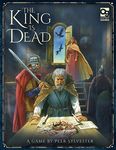 • The second edition of Peer Sylvester's 2-4 player, area majority/influence, thinky filler The King is Dead from Osprey Games is slated for release in July 2020.
Here's a high-level overview from the publisher if you're not familiar with this deep, quick-playing gem:
The King Is Dead is a board game of politics and power struggles set in Britain in the chaotic period following the death of King Arthur. For the good of the country, a leader must unite the Scots, Welsh, and Romano-British — not by conquest but by diplomacy.
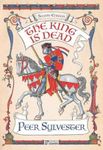
Players are members of King Arthur's court. Whether a loyal knight, a scheming lord, or an ambitious noblewoman, you all have one thing in common: power. As prospective leaders, each player uses their power to benefit the factions, gaining influence among their ranks. The player with the greatest influence over the most powerful faction is crowned the new ruler of Britain.
The second edition has been refreshed with updated graphic design, re-skinned with new medieval-flared artwork from Benoit Billion, and packaged with a new asymmetric game mode for advanced play — all in a more portable format than the original 2015 version.
I was only recently hipped to The King is Dead, but I dig how it has similar elements to Pax Pamir (Second Edition), specifically with the way the area majority/influence scoring works. The flexible hand-management mechanism gives you lots of choices for strategizing since you have the option of playing none, some, or even all of your eight action cards on any turn. It also adds an interesting twist with variable endings that lead to different victory conditions, similar to other Pax games that I enjoy. I can definitely appreciate the amount of depth packed into such a short and relatively simple game.
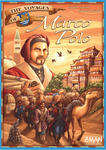 • In November 2019, Eric shared a SPIEL '19 photo of the newly announced Marco Polo II: In the Service of the Khan, which is Simone Luciani and Daniele Tascini's standalone follow-up to the dice-worker-placement classic The Voyages of Marco Polo. I think this one caught us all by surprise, although it's no surprise that I've heard nothing but good things about it, considering its older sibling's esteemed reputation.
Here's what you can expect from Marco Polo II, which is due out in English sometime in 2020:
The journeys of Marco Polo continue in Marco Polo II: In the Service of the Khan, an epic follow-up to The Voyages of Marco Polo. After traveling to Beijing, your travels now take you back to the West in the service of the Khan, sending you to the farthest reaches of his empire in search of wealth and fame.
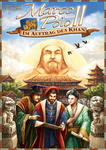
Marco Polo II is a standalone game based on The Voyages of Marco Polo, and you don't need the original game to play this one. This new journey will present unique challenges, with new and different actions, new scoring rules, and a new good: rare and valuable Chinese jade.
Retread old paths with renewed purpose, or find new ones as you explore farther west, continuing to build the immortal legacy of Marco Polo!
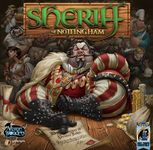 • CMON Limited plans to release Sheriff of Nottingham: 2nd Edition, a new version of Sérgio Halaban and André Zatz's popular bluffing and bribery game from 2014, Sheriff of Nottingham. It's available for pre-order as of April 2020, but the release date is TBD.
Here's a game description from the publisher that includes second edition updates:
Will the merchants get their goods past the Sheriff?
The bustling market in Nottingham is filled with goods from all over the kingdom. Most of it is entirely legal, however, Prince John is looking to make sure no contraband gets sold. He's tasked the Sheriff to inspect merchant's wares, looking for any illicit goods. The Sheriff's shrewd, but not above taking a bribe to look the other way. Which merchant will end up getting the best goods through and make the largest profits in the market stalls?
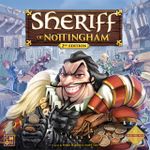
In Sheriff of Nottingham (2nd Edition), players take turns playing the Sheriff, looking for contraband goods, and the merchants trying to stock their stall with the best goods. The Sheriff can inspect any bag they want, but they must be careful as they'll have to pay a penalty if they find the merchants were telling the truth. This new edition includes updated rules, as well as expansions such as the sixth merchant, the Black Market, and Sheriff's deputies.
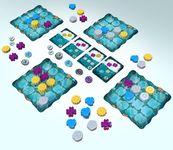
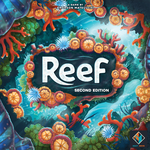 • In August 2020, Next Move Games plans to release a new edition of Emerson Matsuuchi's Reef, which first appeared in 2018. The only changes to the game are to the typography on the front cover and the color of the reef pieces. Says Next Move's Mike Young, "The team wanted more ambiance for the game, so more naturally occurring colors felt like a better fit." You can get a complete rundown of the game in Eric's video overview, but here's the short take:
In the game Reef, players take on the role of a coral reef, carefully selecting colors and patterns in which to grow and expand. On each turn, players can choose to pick up a new card from a choice of four, or play a card that is already in hand. Each card provides two reef pieces and a pattern that scores points if the existing reef has it (after placing the two new pieces). Whoever has the most points when the reef pieces (or card deck) run out wins!
Categorias: Notícias
New Game Round-up: Defeat the Batman Who Laughs, and Look for Restocks of Great Western Terra Mystica
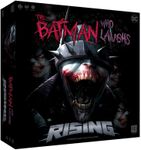 • In a March 2020 post on NY Toy Fair 2020, I mentioned several licensed IPs that I saw at numerous booths throughout the show, with one of those licenses being "The Batman Who Laughs" from DC Comics.
Further evidence of this trend comes from the fifth title in U.S. publisher The Op's "Rising" series of co-operative games: The Batman Who Laughs Rising. In this 1-4 player design from Andrew Wolf and Patrick Marino that's due out in Q4 2020, players must work together to defeat a weird amalgamation of Batman and Joker. In more detail:
In The Batman Who Laughs Rising, a passage from the Dark Multiverse has allowed the most dangerous evildoers to infiltrate Gotham City, and these Dark Knights alongside their menacing leader are eager to do their worst to the city.
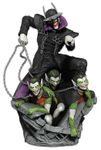
Players roll dice and work together to save the multiverse, starting with one of four starting heroes — Wonder Woman, Green Lantern, Hawkgirl, or Batman — and recruiting allies such as Harley Quinn, The Flash, and Cyborg, whose skills can complete objectives or help recover what is lost to darkness. Take out villainous versions of Batman such as The Merciless, The Dawnbreaker, The Murder Machine, and more before facing off with the psychotic Joker-ized antagonist himself, who's represented by a custom-sculpted, full-color figure who commands a fistful of chained Evil Robins!
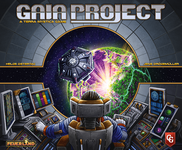
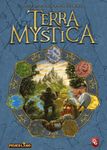 • U.S. publisher Capstone Games has been working with German publisher Feuerland Spiele since 2018, and that relationship is strengthening in 2020 with the transition of the English-language versions of Gaia Project and the Terra Mystica line from Z-Man Games — where those titles first appeared in 2017 and 2013, respectively — to Capstone.
Nothing is changing in the games themselves. As Capstone notes in a press release announcing the deal: "As we gear up for continuous production cycles, our goal is to prevent any issues of availability of Terra Mystica and Gaia Project. Although the logo on the box may be different, future reprintings will be fully compatible with existing stock." The two games are due out in Q4 2020, along with the Terra Mystica expansions Fire & Ice, Merchants of the Seas, and Mini Expansion 1, the exact contents of which is unknown to me.
 • Speaking of restocks, eggertspiele notes on Facebook that roughly two thousand copies of Great Western Trail are headed to the U.S. and "we aren't expecting to have another shipment until October". If you want a copy, pester whichever store you buy from to secure a copy for you. Good luck!
Categorias: Notícias
Game Preview: My City, or A Tile-Laying, City-Building Game That Gives You Fits
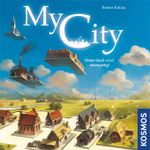 My City is a city-building legacy game from Reiner Knizia and KOSMOS, and despite my love for Knizia's work — as expressed in this overview of L.A.M.A., for example — Knizia and the legacy format is an oil-and-water combination that doesn't deliver what I want to see from his designs.
At heart, My City is akin to Knizia's FITS, a 2009 nominee for the Spiel des Jahres. In both games, each player receives their own playing board and set of polyominoes, and gameplay is Bingo-style, with someone revealing a card that depicts one of the pieces, then everyone playing that piece onto their board.
 In both games, you're generally trying to cover as much of the board as possible since you lose points when any of the background material is visible; some spaces provide positive points, though, so you try to build around those while covering everything else, but the odds of you getting the tile you need at any one moment are often against you, so you must make do the best you can.
In FITS, you can pass as many times as you wish, placing the tile to the side and knowing that you'll never have another chance to play it; in My City, you must pay 1 point to skip placing a tile, but you start with a reservoir of 10 points, which is far more than you'll need in most games.
If you can't place a tile on the board in My City or choose not to place a tile, you can spend 1 point, place the tile face down out of play, and continue. Alternatively, you can declare yourself done with the game and calculate your score, gaining 1 point for each visible tree, losing 1 point for each visible rock, and losing 1 point for each visible light-green space.
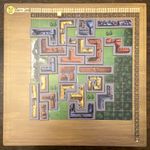 End of episode #1: Gain 8 points for trees revealed,then lose 12 points for empty spaces uncovered
Whoever has the most points wins the episode and fills in two progress symbols on top of their game board, that is, literally fills in those symbols with a marker. In a game with three or four players, the player with the second-highest score fills in one symbol.
On top of this, the winner of this first must place a sticker with two rocks on their board while the third and fourth players (or the second player in a two-player game) must place a sticker with one tree on their boards. Thus, in each episode that winner makes important progress toward the long-term goal — having the most progress symbols at the end of the 24-episode legacy campaign — while receiving a possible impediment for the episodes to come, an impediment that might be of no consequence given that you're actively trying to cover as many non-tree spaces as possible. Those with poor scores receive a minor boost, filling an empty space with a tree so they won't lose that point in the future, with an additional point coming if they manage to build around that tree.
This basic structure of gameplay in My City remains the same throughout the 24 episodes of the legacy campaign — flip a building card, place that building on your board — but as you might expect, things get more complex in subsequent games. In episode #2, the building colors become important, with you gaining points for the largest contiguous block of each color; place five yellow buildings together, for example, and you've earned yourself five additional points. In episode #3, each player adds a well to their board, and if you place a different building on each side of the well while keeping the well visible, you earn 4 points.
[o]
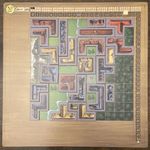 [/o]Final board in episode #3
My City includes eight "chapter" envelopes, with each chapter containing the new rules, stickers, scoresheet, and other elements for the next three episodes in the legacy campaign. Chapter 2, "The Churches", adds new buildings to the game, while Chapter 3, "The Flood", lets you build in the forest, which was previously off limits.
I've given light spoilers for My City to this point, and I'm going to reveal much more in the remainder of this post (and the video below), but I'd argue that none of it matters in the overall flow of the campaign. If you prefer to know nothing — an attitude I respect given that I avoid seeing trailers for movies that I intend to see — then you shouldn't even look through the box given that the names of the chapters give you some sense of where things are heading.
I's argue that none of that info matters, though, because My City doesn't tell a narrative in the style of Pandemic Legacy: Season 1, the only other legacy game that I've played. (Disclosure: I was paid to edit the rules of Zombie Kidz Evolution, but I still haven't played it.) Knowing that, for instance, Chapter 4 is titled "The Gold Rush" and Chapter 7 "The Railroad" will have no effect on how you play earlier episodes. Placing a rock or tree here or there is mostly irrelevant in the flow of the overall campaign, and each element that's introduced is important only once it's introduced. You'll have a well for a few episodes – or multiple wells if you don't do well in episode #3 — then the wells go away. You'll have a sawmill, then the sawmill vanishes along with some of the forest. You'll mine gold for several games, then those mines close.
[o]
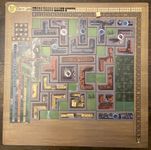 Episode #18, with you trying to connect colored buildings to the proper mines[/o]
My City has a sandbox feel that loosely tells the story of a city over time, but little that you do has real consequence to the overall goal of the campaign, that being to score as many progress symbols as possible. With the gold rush in Chapter 4, you do gain a new way to earn progress symbols: Have more gold nuggets than all other players, with you earning a nugget by being the first player in each episode (starting in episode #10) to connect the two gold mines with a group of contiguous buildings or possibly by being the first to cover the forest with buildings.
I realize now, only after having finished the 24-episode campaign and recording a loooong video about the game that we probably scored this nugget bonus incorrectly, and this brings up one failing with My City, a failing common to many legacy games: the rules.
In general the rules are short, simple, and clear, but the envelopes introduce new rules and bonuses, and it's not always clear when something should apply. The rules for Chapter 4 introduce that nugget-based progress rule described two paragraphs above, but we applied that rule for all three episodes in Chapter 4 whereas I think now you're supposed to apply it only after you've completed all three episodes in that chapter. (The end of the rules for episode #10 direct you to "take a look at the bonus at the end of this rule sheet", so we did, then we applied that bonus after each episode. Ideally the rules would say "Apply this bonus after each episode" or "Apply this bonus only after episode #12", whichever the case is.)
The rules for a chapter often say something like, "All the rules for episodes 13 to 18 apply", which is not necessarily helpful given that the rules often change. Most of the time you can't build over the forest, but sometimes you can; most of the time your first building must touch the river, but for a while it must touch the sawmill. I think we got most of the rules correct, but having all the rules in one place would be preferable, similar to how Pandemic Legacy: Season 1 has stickers that you apply to the rulebook so that you can have a singular reference point for all your questions.
[o]
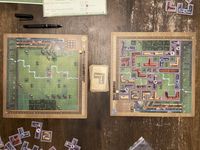 Episode #24: In this episode, you can't build over trees and your first building must touch the red-roofed palace; the first building revealed was the plus-shaped church, which I couldn't place — and if you can't place a church, you're done for the round. As a result, I placed nothing![/o]
More rules that allow you to gain progress symbols are introduced with the mine that replaces the mountain in Chapter 6 and the railroad that arrives in Chapter 7, and gaining those symbols is your overall drive at all times. Getting a minor penalty or losing out on a small bonus means nothing compared to the larger goal of collecting those symbols, so you will always be focused on winning every episode no matter what.
I played the campaign, as well as the "eternal game" (more on that below), with my exchange student Lisa on a review copy from KOSMOS, and while she enjoyed the legacy aspects of the game — the constant flow of added rules and oddness of writing on the board being something new for her — she didn't focus on the larger campaign. She won multiple episodes, often edging me out by only one point or even winning on the tie-breaker — thus demonstrating the importance of every action and every bonus or penalty — but she didn't focus on the larger multi-episode goals such as developing her mine or railroad, and her long-term progress suffered for that.
Thanks to the double-sided game boards, My City includes a way to play without the legacy elements of gameplay, although you will need to pull a few components from the envelopes in order to have all the parts you need to play. In essence, the eternal game is akin to episodes #8-10, with each player having a well, and the player who first connects the gold mines scoring 3 points. Aside from the gold mine, though, you're on your own, with your actions having no impact on others, similar to FITS.
[o]
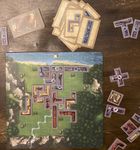 [/o]An example of a completed "eternal game"
Playing the eternal game twice after having finished the campaign cemented my opinion that legacy games shouldn't be in Knizia's wheelhouse in the future. What I love about his designs are their streamlined nature, with the simplicity of the design hiding depth that's revealed only through multiple playings as you gain a better understanding of the flow of the game and how your early decisions can impact everything else — but with My City, I felt like all the new elements were getting in the way of what I wanted: a better sense of how to play the game, with Knizia not delivering the Platonic ideal of a game design as he usually does, but instead placing you on a vehicle that keeps evolving as you steer it.
That said, Knizia used the legacy aspect in a smart way, with the basic mechanisms of the game feeling like how a town would be built — start next to the river, then grow from there — and with the legacy elements serving a purpose, then disappearing. You can mine the mountain for only so long, for example, so hit it while you can! Of course you should be doing that anyway since some of the bonuses are available only to those who reach them first. The same goes for the railroad, with you needing to race for earlier bonuses at the risk of losing out and needing to extend your line even further before you can reach the bonuses available to all.
Despite my preference for the eternal game, I'd play the legacy version of My City again, if only to see how it plays out with three or four players instead of only two. With two players, everything is win or don't win, with no in-between. You have only one competitor in the race for gold nuggets or expansion in the mine or connection with the railroad, so the game feels easier than it would with more players. That statement is a testament to how much I appreciate Knizia's designs: Even when they're not expressing his strengths as well as I think they could, I'd still play them over most other games. I have a feeling that most people will enjoy the ride of the legacy campaign far more than I did, and regardless I still have the eternal game available for continued play, which gives us all the best of both worlds.
For more spoilers and a long discussion of what I love about Knizia's designs, check out this video overview:
Youtube Video
Categorias: Notícias
Solitaire Sunday: Blokus Puzzle, or Cornering Solutions
 Bernard Tavitian's Blokus is a brilliantly simple design that has been on the market continuously for two decades, with the core concept of the game being transferred into other designs (such as Blokus Trigon) and being retroactively shoehorned into the line (as with Blokus 3D).
U.S. publisher Mattel bought the Blokus line in the late 2000s, and in the past two years it's released two items that use the core concept of the game in new ways: 2019's Blokus Dice Game (which I covered here) and 2018's Blokus Puzzle, this being a logic puzzle instead of a game, with the puzzles being designed by Nick Hayes.
Blokus Puzzle includes 48 challenges, with challenges coming in three types, but all having the same principles: Slide the challenge card into the plastic holder, take the 3-5 pieces depicted on the bottom of that challenge, then place them in the plastic grid to fulfill the current goal. As in Blokus, all the pieces you place must touch at least one other piece of yours — whether one you place or one of the blue pieces printed on the challenge — and your pieces can touch one another only at the corners. You can abut the black pieces printed on the challenge card, but not cover them.
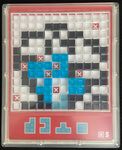
Here are the three types of challenges:
• Red: Build off the blue piece printed on the challenge to place all of the pieces depicted without covering any of the Xs. I've included a completed challenge above.
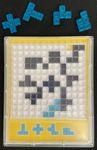
• Yellow: Build off the blue piece printed on the challenge to cover all of the stars printed on the challenge card. Cards have 1-3 stars printed on them.
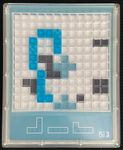
• Blue: Place the depicted pieces to connect the two pieces printed on the challenge card.
Challenges escalate in difficulty within each type, and each challenge has multiple "false paths" in which pieces seem like they'll achieve whatever the particular goal is — only to discover that the final piece doesn't fit anywhere, which then forces you to backtrack or swap pieces in the hope of finding room for all the bits.
I'm sure that my experience playing Blokus and many other polyomino-based games helps me have an easier time solving these puzzles, but even the first puzzles can be tricky if you don't read them the right way. You need to be open to finding new paths, although in some cases you'll realize that the five-block piece can fit in only a few spaces, which narrows the choices for where you might build.
I've played Blokus Puzzle repeatedly over the nearly two years that I've had it, with Mattel giving me a review copy at Gen Con 2018. The puzzles thread the needle of being challenging, but not impossible. If you want, you can methodically attempt all the possible layouts as the number of possibilities isn't enormous, but it is large enough that you want to avoid that, if possible — and with experience you start to see where pieces can go, their shapes almost popping out of the grid at you.
For more on Blokus Puzzle, check out the video below:
Youtube Video
Categorias: Notícias
COVID-19 at the Gaming Table VIII: Play at Home Thanks to Czech Games, Helvetiq, Big Potato, and Space Cowboys
 • Should you be looking for another party game to play via camera, albeit with one person giving all the clues, UK publisher Big Potato would like to present you with Goat on a Boat, a rhyming- and celebrity-based charades game in which you need to make others guess phrases like "Jessica Biel wrestling an eel". You can download the PDF here.
 • Swiss publisher Helvetiq has released a special COVID-19 branded version of its co-operative game Bandido from designer Martin Nedergaard Andersen. In the original version of the game, you collectively place tunnel cards to try to shut of avenues of escape for a bandit; in this new version, available on PDF and containing fewer cards than the original game, you need to cut off the virus' tunnels of access to other people.
• Czech Games Edition is releasing a new edition of Tomáš Uhlíř's Under Falling Skies in 2020, a game that won several categories in a nine-card nanogame design contest on BGG in its original version, including best overall game.
You can watch an overview of the game in this video that BGG recorded at GAMA Expo 2020, and if you want to try it out for yourself, CGE has posted an updated (yet not final) version of the game on its blog that you can download and play. If you downloaded the game previously, you can focus on the changes made to the game in the final section of that blog post.
 • Space Cowboys has released downloadable files of TIME Stories Revolution: Damien 1958 NT, a demo scenario by Manuel Rozoy and Vincent Goyat for the second cycle of TIME Stories that won't be used at conventions anytime soon. For those files, along with info on other titles in the TIME Stories Revolution series, head to the Space Cowboys website.
• Catalyst Game Labs is offering a free downloadable novel or anthology set in its BattleTech and Shadowrun universes through its webstore. Use the one-time-per-person, case-sensitive code Catalst-C19 by May 15, 2020.
• In a Yahoo! News article from early April 2020 titled "3D printing enthusiasts join fight against coronavirus", BGG user Oscar Valera (username: [user=usual21]Usual21[/user]) got a callout in the text and video for printing and distributing "200 face shields to medical professionals across the country". Valera was spotted by a BGG user who recognized several modern hobby games on the shelf behind him during the clip.
Categorias: Notícias
New Game Round-up: Organize Books, Escape a Castle, and Set Up Trading Offices in Novgorod

 • U.S. publisher Renegade Game Studios has announced a new design from French group L'Atelier, which has previously designed One Key and Obscurio for Libellud.
Here's an overview of Atheneum: Mystic Library, a game for 2-5 players due out in September 2020:
The magic exam is tomorrow, but you and your fellow students haven't studied at all! You head to the library to cheat, using magical books that don't need to be read. All you need is to knock your magic wand precisely on a stack of books and « TA-DA! » the subject is learned by magic. However, to get you inside the library, you've promised the guard to clean up and organize the shelves in exchange for for him overlooking this intrusion at night...
In Atheneum: Mystic Library, you must study for the exam while cleaning up the library! During the game, you can score points for objectives by placing books on your shelves in specific configurations. At the end of the game, you score points for full shelf compartments, decorative candles, and shelved books of your favorite subject. Whoever collects the most points wins!
 • In October 2019, I covered the two-year publishing plan of German publisher Spielworxx, which includes a new version of Karl-Heinz Schmiel's Tribune: Primus Inter Pares and the Tribune Expansion with a planned release date of Q3 2020. Stronghold Games has announced that it will be the North American publishing partner on this project, with a Kickstarter planned for late April 2020.
 • Since 2015, designer Stefan Risthaus of OSTIA Spiele has been working his way through locations on the Baltic Sea or in the Baltic states with a series of small games: Visby, Tallinn, Riga, Riga: Lubeca, and Vilnius.
For 2020, he's moving a bit more inland with Novgorod, a 2-4 player game set in this city located south of Saint Petersburg and east of Estonia. The game is being crowdfunded on Spieleschmiede (link), and while the game will include rules in English and German, full rules are available right now only in German (PDF). For now, here's a brief overview:
In Novgorod, players build kontors (trading offices) in Hanseatic cities to ship goods and manufacture luxury products. These are necessary to fulfill missions that give you victory points and allow you to step forward on your career card.
Balancing between building enough (but not too many) kontors, improving your ship, and figuring out the idea ratio between earning money and collecting victory points is crucial.
 • A far larger crowdfunding campaign is nearing its end for Archon Studio's Wolfenstein: The Board Game, a design based on a video game series that is not as I originally expected about lycanthropic Frankenstein monsters, but about efforts to escape the German stronghold of Castle Wolfenstein in an alternate reality World War II — so I was about 7% correct.
Here's an overview of this 1-4 player game that's due out in Q3 2021:
Wolfenstein: The Board Game takes place in the legendary Castle Wolfenstein and — like the action of the flagship, award-winning games developed by MachineGames, Wolfenstein: The New Order and Wolfenstein: The New Colossus — occurs in the early 1960s in a world in which the Nazis won the Second World War.
Playing as BJ Blazkowicz, Anya Oliwa, Set Roth, Max Hass, and Bombate, players have to infiltrate the castle, then contend with Nazi antagonists controlled by the game's AI mechanisms. Depending on the chosen game, players will encounter Nazi zombies, mechanized Nazis, or a mixture of both. The set also contains an iconic unit known from the legendary Wolfenstein 3D — Mecha-Hitler!
Controlled by players, BJ and his companions — in the form of 32 mm plastic figurines — must fight through the hordes of Nazis, explore Castle Wolfenstein, and perform dangerous missions, all to defeat the sinister plans of Adolf Hitler and his two cruel subordinates. Additional known characters will be available in future add-ons and expansions.
You can check out the Kickstarter campaign (KS link) for more details.
Categorias: Notícias
Game Preview: Ankh, or One Egyptian God to Rule Them All!
 First, we were mighty Viking clans battling for the most glory at the end of the world in Blood Rage. Then we were clans in feudal Japan negotiating and battling our way to victory in Rising Sun. In Eric Lang's latest epic, Ankh: Gods of Egypt, the legendary saga continues; we'll use our unique powers to earn the most devotion to become the one and only god of Egypt!
In April 2020, I had the privilege of playing a partial game of Ankh on Tabletop Simulator when Eric Lang demoed it for the BGG Team just days before CMON Limited launched its Kickstarter campaign for the game. Spoiler alert: I left the demo knowing I had to have this game in my collection.
In Ankh, 2-5 players compete as ancient Egyptian gods as history advances from polytheism to monotheism. Using unique asymmetric powers and mythical guardians, players build and control monuments, gain followers, and battle each other for territorial control, all with the goal of earning enough devotion (i.e., victory points) to be the one and only God of Egypt.
During the game, players take turns in clockwise order performing one or two actions until the game end is triggered. The actions include moving figures on the board, summoning figures onto the board, gaining followers, and unlocking Ankh powers. Followers are essentially your currency in Ankh — you will need to sacrifice followers to build monuments, bid in battle to avoid the dreaded "Plague of Locusts", and unlock ankh powers, that is, special abilities and bonuses that will make your god even more powerful.
 Cat-mummy guardianThree levels of ankh powers are common to all players. In each game of Ankh, you can unlock up to two in each level, starting with level 1. The different ankh powers combined with each god's unique ability will add plenty of variety to each game and offer players fresh ways to strategize game after game.
Unlocking ankh powers will sometimes reveal a guardian icon that will allow you to add a guardian creature to your pool of warriors. These guardians have their own special abilities, and each type is limited, so not everyone will get to add every type of guardian. Once they're in your pool under your control, you can summon them like your warriors that you have from the start of the game.
 Central dashboardThe core gameplay of Ankh is centered around the central dashboard, which has a track for each of the four actions and an event path. The actions and events individually are straightforward, but the way they work together creates a thinky decision space that had my mind buzzing, even from the small taste I got from a handful of turns. Each time a player takes an action, the corresponding action marker advances on its track. When an action marker hits the end of its track, it advances the event marker and triggers the corresponding event. After the event is resolved, the action marker returns to its starting space — rinse and repeat.
The events are pretty awesome. You really want to be the one triggering them every time while your opponents stare in envy from the sidelines as you:
• Gain control of a monument to align yourself strategically to gain followers and area majority when it comes to conflict events.
• Claim the battle tiebreaker token in a conflict event and win a tie during a battle.
• Deploy a caravan of camels on the board, splitting an existing region into two new regions to manipulate how area majorities are evaluated during conflict events.
Regardless of the event, again, you will typically want to be the one who triggers it — but the reality is that everyone quickly realizes how juicy these events are and watches like a hawk as the action markers creep toward the event-trigger zone, trying to time things precisely so that you're the one who triggers the event. There were moments when I knew exactly what I wanted to do on my next turn, but then as my opponents took their turns and I saw the action markers moving closer and closer to the end of their tracks, I had to rethink my plans. I kept thinking, How can I avoid helping my opponents trigger events while at the same time trying to set myself up to be on the receiving end?
 Isis in color (image from CMON)Conflict events are the meat and potatoes of Ankh, with them resulting in fruitful devotion payouts for the cleverest of the gods. Your turns and actions leading up to the conflict events are typically to position yourself as best as possible to win battles and monument majorities and thereby to score as much devotion as you can. Each conflict is resolved in order based on the conflict order tokens assigned to each region. Conflict could result in individual players dominating regions and earning some devotion peacefully, but more often than not, a battle is going down.
When resolving conflict, any regions with figures from two or more players will result in battle. Players involved in a battle secretly select a battle card, placing it face down in front of them, then all players reveal them simultaneously. Each player has six battle cards with which to work, but once a card has been played, it remains face up in front of you until you play the "Cycle of Ma'at" card, which is the only way to return all of your battle cards to your hand. Battle cards can modify your strength and grant you special abilities, which reminded me a bit of how the combat cards work in Lord of the Rings: The Confrontation, so they create similar suspenseful feelings before each reveal.
 Devotion trackAfter the first two normal conflict events are resolved, the remaining conflict events are special and may trigger the end of the game. At the end of the third conflict in a game with three or more players, the two players who are lowest on the devotion track merge their gods together to form a super god with combined powers! Then these two players play co-operatively against the remaining players until the end of the game.
Not only is this a solid catch-up mechanism, but the power of merging gods might lead some players to intentionally strategize ways to position themselves lower on the devotion track specifically to merge gods with another particular player.
After the fourth conflict, all players in the red zone of the devotion track are eliminated from the game. Therefore, if all players are still in the red zone at this point, the game ends immediately with no winner. The people of Egypt essentially revert to atheism. On the other hand, if only one god (or the super-merged-mega god) survives, that god becomes the one and only god of Egypt and wins. Otherwise, players continue until the fifth conflict is resolved, which triggers the end of the game. In that case, whoever is highest on the devotion track wins.
 Ankh Gods
Not only did I find the mechanisms in Ankh quite impressive, but oh my Egyptian God (!!), the art and minis are top notch! Adrian Smith, Mike McVey, and his sculpting team really worked their magic here to fully immerse us in the theme. The art and miniatures are amazing and oozing with unique Egyptian vibes. The minis are so intricate and detailed that the guardian creatures are pretty creepy. I think we all jumped out of our chairs a bit when we zoomed in on the cat-mummy for the first time.
Ankh is highly thematic with incredible artwork and some of the most intricate miniatures that I've ever seen, but these strengths are merely sprinkles on top of a well-designed game that is rules-light and strategy-heavy with plenty of player interaction and variety to keep things interesting with each game you play. Considering how much I enjoyed playing Ankh on Tabletop Simulator, I'm looking forward to actually sitting at the table with friends to play a full game of Ankh when it's released.
Categorias: Notícias
COVID-19 at the Gaming Table VII: Game at Home with Cats, Dragons, Pigs and Pencils, Then Visit a Clinic to Fight COVID-19
 • Frank West of The City of Games has released a "remote edition" of The Isle of Cats with modifications that allow you to play with others via a camera as long as at least one player owns the game.
• Along similar lines, Wizards of the Coast has set up a Dungeons & Dragons remote page with free material that you can download, primarily adventures for those playing the game and coloring pages for youngsters who love fantasy material.
• Designer Mitsuo Yamamoto of Logy Games has designed dozens of games that use ceramic or wood bits — that is, items similar to what you might find around your house — and in response to the current situation, he's been designing lots of games that use precisely those components you'll find around the house. You can find all of his home made games here. Says Yamamoto, "I have already created twelve games and will finally have a total twenty games at least. All ideas are free to make games by yourselves. I am sure and hope this suggestion will be helpful for all people who are protecting to coronavirus all over the world."

 • Do you want another roll-and-write game to play at home or via cameras with others?
If so, then designers Mike Mullins, Ben Pinchback, and Matt Riddle are happy to present Tiny Farms to you, this being a game for 1-4 players available in a print-and-play format here on BGG courtesy of publishers Dice Hate Me Studio and Motor City Gameworks. Here's an overview of how to play:
Each player is a farmer managing two 4x4 farms. On a turn, animals are drafted and placed on the farm by writing their initials (or by drawing, if you're feeling creative). Drafting involves a special rondel with eight sections containing the animals. The rondel is overlayed by a wheel with different hole patterns — the patent-pending Rolldel Wheel-o-Matic! — that reveal only two animals in each section. As the wheel rotates, different animals will be available. One red and one blue meeple travel clockwise around the rondel.
Each round, roll dice equal to the number of players, plus one. Players then take turn drafting a die, moving either the red or blue farmer meeple that number of sections, and placing the two animals from that section onto their farm that matches the color of the farmer. The last die remaining after all players have taken one is used to rotate the wheel.
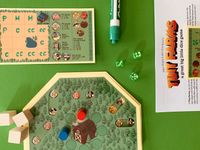 Image from BGG user EllenM
Players also start with some milk tokens that can modify the values of dice by ±1.
The game ends after ten rounds (with your farms hopefully now being full), and players score points. Each animal has a different scoring conditions, such as sets of adjacent animals of the same kind or different kinds, or the most animals of a kind between all players. You also get points for unused milk tokens, and lose points for any size difference between your two farms.

 • Designer Alban Viard is running a Kickstarter campaign (KS link) for a new Clinic Deluxe Edition: Covid-19 expansion from AVStudioGames that transforms Clinic: Deluxe Edition into a co-operative game.
You can purchase just the expansion — or the base game, the extension, and the expansion — and for each copy of the new Covid-19 expansion backed, Viard has promised to donate €10 from his personal funds (up to €15,000 total) to Institut Pasteur and Salk Institute for Biological Studies.
 Update, April 22, 2020: In Germany, Oktoberfest — which was scheduled to run Sept. 19 to Oct. 4 — has been cancelled. Here's an excerpt from an NPR article about the closure:
"The risk is quite simply too high," Bavarian Minister President Markus Söder said during a press conference on Tuesday.
Munich's mayor, Dieter Reiter, described the cancellation as a "bitter pill" for the city but said that officials had no other choice. "You can't host a folk festival in a time like this," he said.
On top of this, Berlin has cancelled the Berlin Marathon following a decision by the Berlin Senate to ban "all events of more than 5,000 people through Oct. 24", as reported in The New York Times.
That said, these announcements coincide with Germany relaxing some of its stay-at-home restrictions. Again, from the NPR article:
A number of small shops with a retail space of less than 8,600 square feet were allowed to reopen on Monday.
"The increase of infected people is slowing down, and our medical services are not overrun by people requiring hospitalization," German MP Jürgen Hardt told NPR last week.
Germany reported 1,775 news coronavirus cases on Monday, which was the lowest number of new infections since mid-March.
Essen is located in a different land — that is, a German federal state — than both Munich and Berlin, and the organizers of the annual SPIEL game convention in Essen, Friedhelm Merz Verlag, sent this notice to exhibitors on April 21, 2020 following these cancellations:
At the moment most of the exhibitors from all over the world are already registered and we hope that the fair can take place in 6 months, even though the Oktoberfest was cancelled yesterday by the Bavarian government and the city of Munich. For North Rhine-Westphalia, the federal state in which Essen is located, it is currently the case that events are not allowed to take place until 31st of August 2020. After that date, the city or state will make a new decision. Of course, we are also dependent on this expected decision and have to wait until 31st of August.
Categorias: Notícias
Guess Numbers with Care, Then Build a 5x5 Zoo with OKAZU Brand
 • For the past several years, Hisashi Hayashi of OKAZU Brand has released two new games — always with art by Ryo Nyamo — at each Game Market, and he had planned to do so again at the Tokyo Game Market event scheduled for April 25-26, 2020, but of course that event will no longer take place.
Instead these new titles, along with titles from 2018 and 2019 such as Across the United States and Goat 'n' Goat, will be available from the Arclight online shop, which is allowing JP designers and publishers to sell new TGM titles with (as I understand it) no commission being charged to those parties. (Arclight ships packages only within Japan, but you could use a forwarding service such as Tenso to receive packages from Arclight, then have them sent to you.)
One of the new OKAZU Brand titles is Suzie-Q (スージィ・Q), with this being a double-blind, bluffing/guessing game of sorts for 2-5 players. Here's an overview of how it works:
In each of the five rounds of Suzie-Q, players choose and write a three-digit number on their secret sheet, hoping to score points based on the numbers that other players have written.
At the start of each round, you write a three-digit number using the digits 0-9, repeating numbers as you wish, but not using any number that you've Xed in a previous round. Everyone reveals their number at the same time, then you arrange them in order from high to low.
Starting with the highest number, you check to see whether any of the digits in that three-digit number appear in any three-digit number of lower value. If they do, then that player takes back their board and scores nothing; if not, then the player scores points equal to the first digit in that number and places an X through each digit used in their three-digit number. For example, if the highest number were 882, and no one else had included an 8 or a 2 in their number, then the player would score 8 points and X out the 2 and 8 on their board. This player also circles the bonus number for that round, a bonus given only to the player with the highest number who successfully scored points.
 Player boards
You then look at the next highest number, and so on, with the lowest number automatically scoring points equal to its first digit and Xing all of its digits. In the fifth round, players double their score.
After five rounds, players sum the points they earned over the five rounds. To this sum, they add the quantity of digits that they Xed out. Whoever has the highest score wins!
Suzie-Q includes a variant in which numbers are evaluated starting with the smallest number. Whoever has the smallest number automatically scores, then for the player with the next lowest number, they score only if one or more of the digits in their number is used by the player with the smallest number, etc.
 • The second new title from OKAZU Brand is 5x5 Zoo, a 1-4 player game in which each player creates their own zoo to satisfy the demands of guests. Here's a high-level overview:
In 5x5 Zoo, each player creates their own zoo on a 5x5 game board. What will you fill that board with? Animals, of course, with the game including six types of animals on 1x1 tiles as well as a dozen animals on 1x2 and 2x1 tiles.
In each of the three rounds, you're going to use a worker-placement style system to acquire animals tiles, guest cubes, special action cards, door tokens, and more. Guests come in six colors: five of which match five of the animal colors (and these guests only want to see those types of animals), and a sixth color (white) that doesn't care what type of animal they see. Those are the guests you want most, but of course to acquire them, you must give up other things.
Many of the animal tiles have walls along one or more edge, and these tiles should be placed against other tiles with walls. During the round, you'll place the animal tiles that you've acquired on the board, with these tiles touching one of the four entrances around the perimeter of your zoo, and before the round ends, you'll "lead" the guests through your zoo, with the red cube stopping at the red (carnivorous) animal, the blue cube stopping at the blue animal, and so on.
You might need to snake your way around doors that block direct access to an animal, or you might have a door token that lets you cut through. When you don't have a matching guest for the next animal (or vice versa), the tour that day is done.
After three rounds, the game ends, with players possibly scoring extra points based on their final bonus card, such as the number of rows and columns in your zoo that are filled or the number of rows that have four or five different types of animals.
Categorias: Notícias