agregador de notícias
WordPress 2.8
Ahoy, 
Upgraded…
Everything was returning 404 for a while, there. A little tweak here, some config editting there, and everything is working again…
Phew…
Cheers,
J.
From the Editor: Spiel 09 Preview, and Membership Drive Results
 The beginning of July has historically been the launch date for the Boardgame News Spiel preview, and I’m continuing the tradition with today’s unveiling of the Spiel 09 preview, which once again has been divided into four sections to speed downloading times on both your part and mine. In case you can’t wait until the end of this message to check out the pages, here are links to publishers A-D, E-M, N-R and S-Z.
If you visit those pages and see only introductory paragraphs not followed by huge tables showcasing publishers and their promised new releases, then either you’re not logged in or you’re not a BGN member, which makes it impossible to log in! The Spiel preview is available only to BGN members as their financial support allows me to put in as much time on the preview – not to mention the site as a whole – as I do. Some of the extensive game write-ups included in the Spiel preview will be published later on BGN as standalone items, but if you want to see them all now in one place, you can become a member now for the low, low price of $25.
Still not convinced of the awesomeness of the BGN Spiel 09 preview? Then consider this: If printed in its entirety, the Spiel 08 preview would reach 400 pages, and I fully expect the Spiel 09 preview to reach that size by the time Spiel opens on October 22. To fully appreciate the scope of the Spiel 08 preview, you should visit the Convention Previews page, click through to one of the Spiel 08 pages, and start reading. Even I’m amazed when I look over those files – and I’m the one who put it all together!
On another topic, my spring membership drive is over, and the bottom line is that there’s no way I can remove ads from the site. My goal was 400 new members, which would permit me to adopt the Consumer Reports model of relying only on member support, but the count barely crossed 100, with roughly twenty of those payments coming in the weeks prior to the debut of the Spiel preview.
While I appreciate the support of each member, whether new or renewing, those payments on their own aren’t enough to allow me to ditch the ads. Heck, even with the ads my yearly income is less than what I’d earn from writing for magazines and other clients. Thus, the ads will stay in place, and I’ll start adding other writing work to my schedule when possible. If you run a game publishing company and need someone to edit your rules and other material – and I think you do – write me and we’ll work something out.
New products from MicroArtStudio
Dale Yu: Report from the Spiel des Jahres Award Ceremony
Well, it’s been a whirlwind week here in Berlin, but I’ve got a free hour in the Tegel airport awaiting my flight to Amsterdam, so I thought I’d try to give a quick rundown of the trip! It’s probably an understatement to say that this was the best trip to Germany EVAR… Valerie and I were able to get in a few days of sightseeing before the big day, but I’m pretty sure that the average BGN reader will have about zero interest in that part of the trip – so I’ll save that portion for another day and get to the reason why most of you came to the column this week – to find out what happens at the SdJ award ceremony.
The “official” activities for the award started on Sunday evening. The jury members sponsored a very nice gathering at one of the hotel restaurants, and they graciously provided all the beer and wine you could drink. Though I wasn’t entirely sure, it appeared that invitees included all people that were involved with any of the five Recommended games for SdJ. I would estimate that there were about 80 to 100 people there over the course of the evening – and when I went to bed around midnight – I think that there were still at least 25 people enjoying the evening. There was only a short formal program at this reception – the current speaker of the Jury, Bernhard Löhlein, welcomed us all and then made a quick introduction to the new jury members on both the SdJ and the KSdJ. After this five-minute speech, the rest of the evening was devoted to casual conversation.
While I spent the bulk of the evening with my partners from Rio Grande Games and Hans im Gluck, it was also nice to talk to some game designers (Vlaada Chvatil, Nick Kellet from Gift Trap, Reiner Knizia, Andrea Meyer, and Friedemann Friese) as well as some of the SdJ jury members and other industry folk. It was nice that most people could speak English, and we were generally included in most of the conversation. The evening also turned out to be a great night to try out some of the local beer – at least 2 glasses each of the 4 varieties on tap as well of one glass of the best alcohol-free beer I’ve ever had.
After having the 8 (or so) beers, it was clearly time for bed – but it was definitely a sleepless night as dreams of poppels dominated the night. Lucky for me, we had to be up by 8AM in order to get ready for the “dress rehersal” which started at 9:30 on Monday morning. We were ushered into the press room and we quickly reviewed the protocol for the press conference which was to start in an hour. The room itself was a good size, with a large stage/podium at the front of the room. The left side of the stage was devoted to the SdJ and there was a table in front of the stage which held the five Nominate games as well as the 2 special prizes (Space Alert and Gift Trap). The right side of the stage had the podium and backdrop for the Kinderspiel des Jahres. There was also a display of the five finalists for that award on that side of the room. Then, there was probably seating for 80 in the front half of the room. Like any good wedding, the first two rows were reserved for the folks involved with the finalists for each award. The back half of the room was filled with long tables for the press and then a camera stand at the very rear for cameras (both still and video).
The rehearsal did not take very long (as the actual presentation would only take about 25-30 minutes), so when it was done, Valerie, Jay and I went out the hotel lobby to nervously wait for the award. Bernd Brunnhofer from Hans im Gluck came to join us. This turned out to be quite nice as Bernd was able to explain the details from the rehearsal to us (as it was done completely in German, I only had a general idea of what, if anything, I would be expected to do at the press conference). This little coffee break turned out to be the longest half an hour of the week. We all tried to make small talk, but it was clear that everyone was preoccupied with the increasing excitedness/nervousness of the morning. One double espresso (and two bathroom breaks) later, it was time to return to the room for the big press conference.
While we were sitting outside trying to enjoy our coffee, the surprising large press corps had managed to assemble in the room. I would estimate that there were at least 30 newspaper/magazine reporters there as well as at least 4 radio crews and 6 television cameras/crews. I think that I recognized the logo of every TV channel I remembered from surfing the hotel TV (except Eurosport and the soft-porn channel). Every seat in the room had been taken and there were still at least 40 to 50 people standing around the edges of the room. It was frankly amazing to see the level of coverage for the award – and if I hadn’t have been so nervous myself, I would have paid a lot more attention to the amount of press that were there. It certainly dwarfs any amount of coverage I’ve seen for gaming back home.
Anyways, we had to shimmy our way through the throng of reporters to take our seats in the very front of the room. Bernd had comandeered seats in the very front right corner of the room. As Bernd had the honor of having two games on the short list, he sat between Jay and Ralf zu Linde & Wolfgang Sentker, the designers of Finca. It took a good ten minutes to get everyone in the room and situated, but soon the program was underway.
After a short introduction by the speaker of the Jury (and translated by Fritz Gruber into English), they moved right into the Kinderspiel des Jahres award. The five games were announced alphabetically. When each game was announced, the game designer and a representative from the publishing house came up to the podium. At the same time, a short video (maybe 2 minutes in length) about the game was shown to give the journalists a brief idea of what the game was like. All of the videos were produced by the jury, and I must say that they were very well done. The videos all followed a similar format – they showed some actors playing the game while there was a narration over the top which described the gist of the game. The final bit of each video was how many players could play the game, the recommended ages and the MSRP of the game. Though I was familiar with 10 of the 12 games prior to the press conference, I could see how these well produced videos could quickly introduce non-gamers to the games. Even though I couldn’t understand much of the German narration, I got a really good feel for the two games I hadn’t seen before.
At the conclusion of the video, the speaker of the KsdJ jury then handed the designer/publisher a certificate proclaiming the nominated status for Kinderspiel des Jahres. Finally, it was time for smiling, handshakes and pictures for the press. This same protocol was followed for all five Nominated games. After all the games had been announced, it was quickly onto the award. There was a large poppel on the stage (at least 1 meter in height) which was covered by large black cloth. The cloth was removed, and the game box for Das magische Labyrinth from Schmidt/Drei Magier Spiele was revealed as the winner followed by three or four minutes of exuberant cheering and another presentation. The game designer and the Schmidt representative again came on stage. This time, they each received a folder with a new certificate congratulating them on the Game of the Year. Additionally, they were each given a huge wooden poppel which is the official trophy for the Spiel des Jahres. The speaker of the jury then asked a few short questions of the designer and publisher, and then the KSdJ presentation concluded.
Once all the celebrating and picture taking were finished for the KSdJ, the program then moved on to recognize the two special awards from the jury this year. The designers of Gift Trap and Space Alert were up on stage – along with representatives from CGE and Heidelberger. Again, a short video was played for each game, and then all of the folks up there were given their poppel, certificate and a hearty handshake.
With the special awards out of the way, now it was time for the main award. By this point, I’ll admit that I was really having time keeping my palms dry. I really didn’t think that I was nervous when the morning started, but the anticipation kept building throughout the morning. Now that the time had come for the award, I was pretty sure that I was hyperventilating with a heart rate in the 120s. The only comforting fact was that Valerie looked to be in the same shape (or maybe worse?!) as me. I couldn’t really see how Jay was doing (as he was sitting in front of me), but he seemed pretty fidgety as well.
As it turned out, Dominion was the first game alphabetically, so it was introduced first. Donald Vaccarino, the designer of the game, was unable to make the press conference, so Bernd from HiG and Jay from RGG were invited up to the stage while the Dominion video played. Now, I’m sure that my view of the video is a bit skewed because of my involvement with the game (and because I couldn’t understand too much of the German narration) – but the video sure seemed to focus on a lot of shuffling! I started to panic because one of the most common complaints I hear about the game is on the frequency of shuffling, and I was worried that the jury would take the same stance. However, the video (and shuffling) were blissfully over soon. Once Jay and Bernd had received their certificates of nomination – all that was left to do was wait!
I’m pretty sure that the other four games were announced in alphabetical order and the appropriate people came up on stage, but I don’t remember any of it. All I could focus on at this point was the huge cardboard poppel and trying to figure out what game box was affixed to it. I spent what seemed like a good hour or so trying to decide whether I could really see a square shaped box hiding underneath the black covering cloth. I was using all of my energy to try to see through that damned black cloth that I almost didn’t realize that all five games had been announced…
However, the complete and total hush that fell over the assembled crowd made it clear that something big was about to happen. Oh, right – it was time to announce the winner of the Spiel des Jahres! Hopefully I won’t be spoiling the surprise, but in what may have been the longest three seconds of my life – the cloth was removed and Dominion was the game affixed to the poppel!
There was pretty much mass jubilation in our little corner. I remember giving just about everyone in our corner of the room a huge hug, and some friends who were seated closeby also joined in. Then, before I knew it, Valerie, Jay, Bernd and myself were whisked up on stage for the presentation of the actual award! Once up there, I was given one end of the SdJ certificates to hold onto and then all I remember is being blinded by about a thousand camera flashes. Not being able to see anything, I just tried to make sure that I was smiling and spent a fair amount of enegry making sure that I wasn’t going to faint from the excitement.
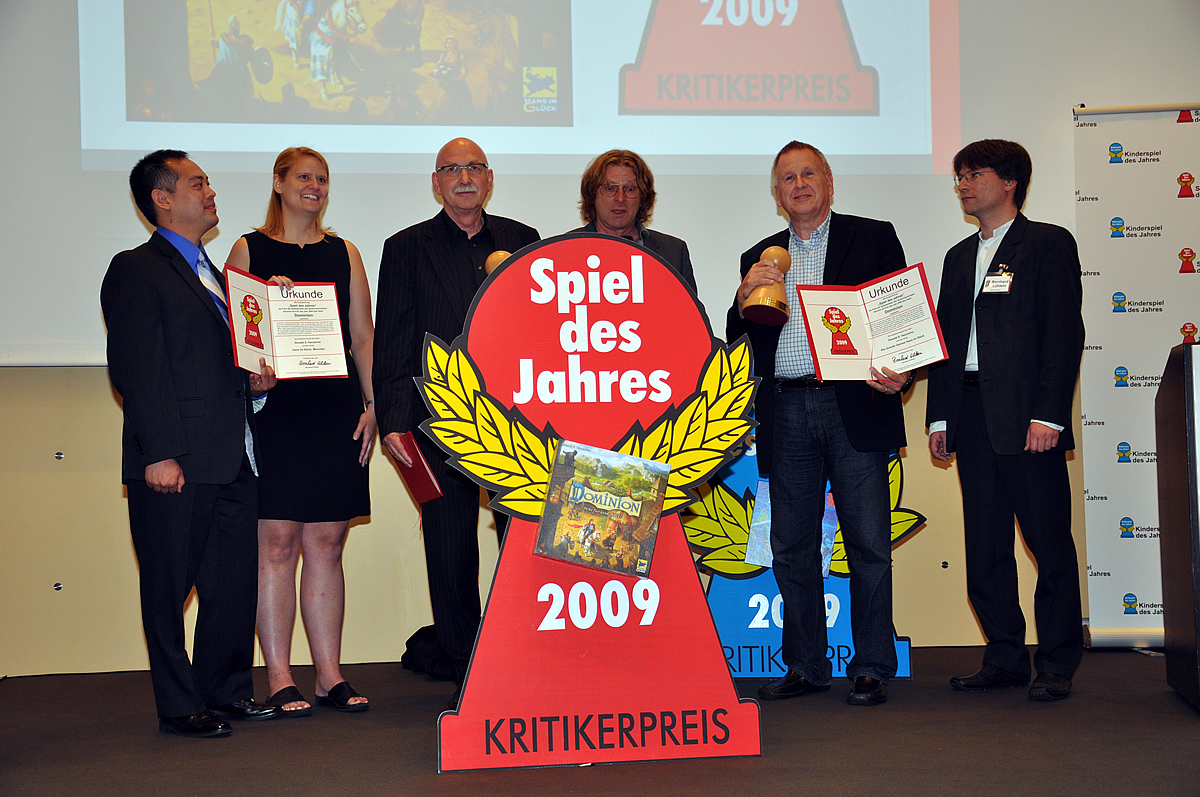
Jay and Bernd were each asked a few questions about the game, and then before I knew it – the ceremony was over. In fact, I was still standing in the middle of the stage with the rest of the team when I realized that half of the room had already stood up and was leaving through the back door into a small reception area. We were instructed that we should also go out into the room, but Bernd was held up with multiple TV and radio interviews. Valerie and I were approached by at least one TV crew for an interview as well, but sadly since we couldn’t speak enough German, they had to pass on interviewing us as apparently it would make for bad TV.
Once it became clear that we (Jay, Valerie and myself) were not necessary for the interviews, we pretty much just stood at a table near the Dominion booth. The reception room was a large square room with booths for all of the nominated games as well as the two special awards. Each booth had a copy of the game on display. Press kits were available for the media to take for each game, and there were plenty of review copies there for the reporters to take home and get a better look at them. There was also a nice buffet spread provided for a light lunch.
I spent most of the rest of the day in a daze. For those of you that have met me before, you’ll probably know that I’m generally never at a lack of words. But for much of the rest of the morning, I’m fairly certain I was standing in the room dumbstruck at the fact that Dominion had won the SdJ! Valerie and Jay were in the same state of mind – so at least the awkward silence at our little table wasn’t just because of me! As we were generally standing around the Dominion booth, most people found us there to offer congratulations. Plenty of people came up to me and seemed to know me by name – which I was at first quite confused by (as I had NO idea who many of these people were) – but I was later reminded that not more than 10 minutes ago I had been standing in the middle of the stage having my name announced to the crowd. Anyways, the reception was pretty open-ended, and it seemed to dwindle to a conclusion in about an hour. To be honest, I think the real reason why people left was the buffet had been completely emptied of food and all of the booths had likewise been emptied of review copies of games.
That pretty much wraps up what happened at the Spiel des Jahres award ceremony. I apologize for not taking any pictures, but it was kind of hard to concentrate that much on the journalistic stuff this year! Well, now it’s time to get to bed (have to be at work Wednesday morning!) and then I have to find a spot on the shelf for the big wooden poppel! Before I forget, let me make sure to thank those people who helped me have one of the best experiences of my life (after marriage and the birth of my 2 kids)—Valerie for working with me as my partner, Donald for designing the game, Jay for asking Valerie (and I) to help take part, Bernd and the HiG crew for all their work making sure the game was viewed correctly by the German gamers, the playtesters on our side (esp. Sir Shufflesalot), and to all the gamers that have enjoyed the game and helped spread it to other gamers! I’m not sure when I’ll ever make it to Berlin again, but it will be quite difficult to ever top this trip!
Until your next appointment,
The Gaming Doctor
Changeling Ready-Made Motley
Top 10 - Junho
The Adventurers and the Temple of Chac - Alderac Entertainment Group
Game Review: Anasazi
By Greg J. Schloesser
June 30, 2009
Designer: Klaus-Jürgen Wrede
Publisher: Mayfair Games / Phalanx Games
Players: 2-4
Ages: 10+
Playing Time: 30 minutes
Rules Language: English / German
Price: $30
Links: 

The ancient Native Americans who lived and prospered for hundreds of years in the early 1000s are a fascinating people. Their legacy includes a litany of intriguing buildings constructed in the deserts and on precipitous cliffs of the American southwest. After flourishing for centuries, the civilization vanished rather suddenly, leaving a mystery that endures to this day. This mystery is the stuff of legend and makes for a wonderful story, and perhaps even an outstanding board game. Sadly, Anasazi by Klaus-Jurgen Wrede, is not that game.
As I learned on my recent vacation to the area, there is no recorded record of the actual name of this group of Native Americans. Modern historians initially adopted the term Anasazi for the group, but this name is now out-of-favor, as apparently it can mean “enemy” in modern Hopi dialect. The name is still used, however, and was even adopted by Wrede for his game.
Over two dozen mesa tiles are arranged on the table in concentric circles. Treasures of four different colors are placed on the pueblos depicted on the mesas. In addition, sixteen towers are placed on pre-designated mesas. Each tower depicts one of the same four colors as the treasures, but the identity of each is initially concealed. Towers serve both as a trigger to end the game, as well as the determining factor for the ultimate value of the treasures collected by the players.
Each player receives seven campsites, of which two will be placed onto the table between the mesa tiles to begin the game. Six base camps are also placed along the perimeter of the mesas. Expeditions will begin from these base camps and meander their way to the various mesas. Players also each receive one secret goal card, which indicates the color of treasure that will be doubled in value for that player.
Game play is quite simple. Each turn, a player perform two actions, including, if desired, performing the same action twice.
- Build a campsite: A campsite is placed onto the table between mesas. After placing a campsite, the player may secretly look at the color of one of the towers. This information can be quite useful when playing expedition tiles.
- Guide an expedition: The player takes one expedition tile and places it onto the table. Expeditions begin at the base camps, and extend from there. The slender, rectangular tiles are laid end-to-end, with each one slightly overlapping the previous tile. The tiles may be turned at various angles, allowing the path of the expedition to be redirected at the whim of the players. The idea is to reach pueblos and collect the treasures – and perhaps towers – located thereupon. A treasure or tower (or both) are taken if the expedition tile touches the pueblo. Treasures are kept by the players, while towers are revealed and placed upon the scoring tile.
If an expedition tile touches a mesa for the first time, the player may secretly look at the tower on that mesa, noting its color. It is important to remember the identity of the towers, as players will want to avoid collecting towers that match the color of their “goal” card. Having as few of these colored towers placed to the scoring tile as possible is highly desirable, as it will increase the value of that treasure.
When a player places an expedition tile that touches one of his own campsites, he may steal a treasure of his choice from an opponent. This is the major incentive to placing new campsites as this theft can deny several points to an opponent and increase your own victory point tally. There is a rule that prevents the placing of an expedition tile over a campsite that was just placed on the same turn. Otherwise, this would be too easy of a task and would not allow opponents the opportunity to attempt to divert the expedition away from a campsite.
Each player tallies the value of his captured treasures, doubling the value of the treasures that match his goal card. The wealthiest player is victorious. They also gain the ignominious distinction of being the most prolific looter of ancient treasures.
In spite of its appealing subject matter, Anasazi falls flat on several levels. First, it fails to evoke the rich mystery of the culture. There really isn’t much atmosphere here. Further, it is difficult to balance the slim expedition tiles when overlapping them. They constantly slide off, causing the tiles to move and shift. In a game where centimeters are critical, this is quite problematic. The art on some of the tiles is also difficult to discern. Expedition tiles depict a tiny human figure atop a ladder, but it is a bit too diminutive for my aging eyes. The color of the base camps is also difficult to discern. Brighter colors would certainly have been easier.
Unfortunately, game play is also lacking. Players are hesitant to move an expedition close to a treasure lest an opponent use his turn to reach and claim the prize. Sadly, there really aren’t many alternatives, as inevitably someone will eventually begin moving the expedition towards the treasures. More often than not, being able to grab a treasure is due to the tile placement of the player immediately preceding your turn. There is no disincentive to collecting treasures, so players will grab any treasure within reach. Perhaps if certain treasures were harmful to a player, then there would be an incentive to exercise other options. As is, there aren’t any.
Fortunately, Anasazi plays to completion in 30 minutes or so. Its short duration, however, cannot overcome its flaws and general blasé feel. There simply isn’t anything exciting here. It is truly disappointing that the game couldn’t have done more justice to such a fascinating culture and subject.
Origins 2009 Report from Ted Cheatham
 Ted Cheatham was at Origins 2009 this past weekend, checking out the new games on display and talking with designers and publishers about upcoming releases, and he’s filed this report.
XPs, Rewards and Pacing
Hoy,
So, after a two-year absence over at the Forge, I started a new Actual Play discussion there:
[3.x/4e] Encounter XPs are not a reward, they are a pacing mechanism
I could have posted it here, but I’d rather tap into their collective wisdom, on this particular topic.
Cheers,
J.
Origins: I came, I saw, I played...
Transformers in role-playing games
Substituting toys for miniatures
Semáforo
New Rules for Roll Through the Ages
Matt Leacock has released new rules for Roll Through the Ages that add more developments to the game and increases the playing time. The Late Bronze Age, as this version is dubbed, doesn’t end until one player acquires seven developments or all of the monuments have been built.
New developments include Preservation, which allows you to spend pottery to double your food, and Shipping, which lets you build ships from wood and cloth, then use those ships to trade goods for other goods. To adjust for these changes, some existing developments, such as Medicine and Religion, have had their costs and values altered. Every monument can be built in the Late Bronze Age, no matter how many players are in the game. New score sheets that incorporate all of these changes are available for download on the rules page.
Evil GM Fundamentals: Creating Atmosphere through Memorable Scenes